


In early April 2021, crews at Florida’s Piney Point phosphate plant fought to stop a leak in the liner of a reservoir that had held 480 million gallons of wastewater. On Saturday night, an attempt to plug the leak with rock and sand failed. “They reached a point where they were about to celebrate and then it blew through,” said Manatee County’s administrator, Scott Hopes. Governor Ron DeSantis declared a state of emergency, 316 homes were ordered to evacuate, and hundreds of inmates at the county jail sheltered on its second floor. If the reservoir’s walls gave way, Hopes warned, “The models for less than an hour could be a 20-foot wall of water” [1].
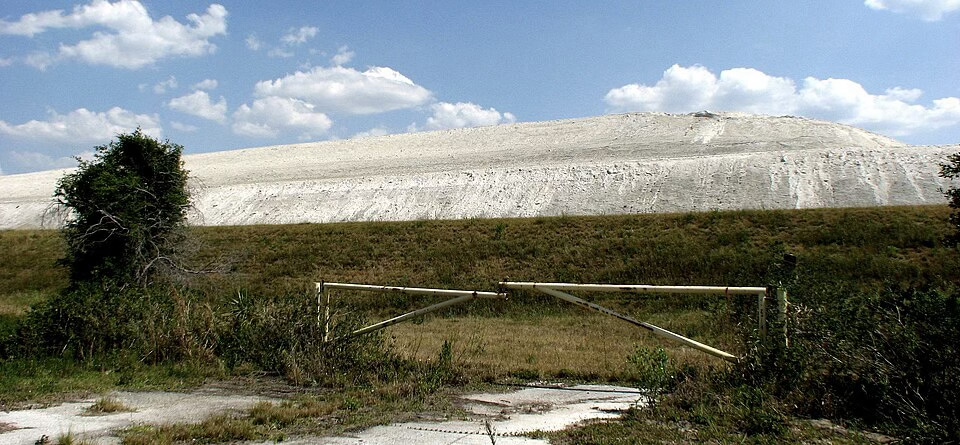
To prevent that, officials had already begun pumping the reservoir into Tampa Bay at about 35 million gallons a day [2]. Some 215 million gallons of process wastewater and 200 tons of nitrogen entered the bay, fueling one of its worst red tides in 50 years and killing more than 1,600 tons of marine life. The reservoir belonged to a former phosphate plant which also contained a stack of phosphogypsum, the solid, radioactive waste of phosphate fertilizer production. In the worst case, a full breach of the reservoir would have also carried part of that radioactive pile of waste into the surrounding waterways and community [3]. Referred to as “Florida’s Mountains”, the state has 25 of these “gypstacks,” holding more than a billion tons of waste [4].
Where do gypstacks come from?
Phosphate fertilizer begins as phosphate rock, which is dissolved in sulfuric acid to produce a slurry of phosphoric acid and calcium sulfate. Once the acid is filtered off, the calcium sulfate, known as phosphogypsum, is left behind as waste [5]. Worldwide, production of phosphate fertilizer produces over 200 million tonnes of waste phosphogypsum a year, and some 4 billion tonnes are stored in stacks called “gypstacks” [6]. In the United States, phosphogypsum may only be deposited in open-air stacks, which can span up to 800 acres and stand about 200 feet tall [7].
A radioactive inheritance
Phosphogypsum’s danger comes from phosphate rock, which naturally contains slightly elevated levels of uranium and radium-226 (Ra-226). Because 80 percent of the radium-226 ends up concentrated in the phosphogypsum, the waste is more radioactive than the original phosphate rock [8]. Radium-226 has a half-life of 1,600 years, so half the radium in a stack built today will still be there in the year 3626. As it decays, it produces radon, the second leading cause of lung cancer in the United States, and chronic exposure to high levels of radium itself raises the incidence of bone, liver and breast cancer [9]. The EPA requires engineered stacks precisely to limit public exposure to radon, but engineered stacks are still a deeply imperfect storage solution.
In October 2024, nearly 15 inches of rain from Hurricane Milton overwhelmed the water system around a closed stack at Mosaic’s Riverview facility, and Mosaic admitted the water had probably reached Tampa Bay [10]. A lawsuit later alleged that at least 39,600 gallons of toxic, acidic process wastewater were released, threatening the Floridan aquifer, which almost 10 million people depend on for drinking water. This wasn’t the first time the aquifer had been contaminated by phosphogypsum stack. In 2016, a sinkhole at Mosaic’s New Wales stack had already drained some 215 million gallons of process wastewater into it [11]. “There just simply is no good way to store this stuff,” said Ragan Whitlock of the Center for Biological Diversity [4].
For some Floridians, the stacks are a permanent neighbor. Progress Village, near Tampa, was established in the late 1950s as affordable housing for segregated Black residents displaced by the construction of Interstate 75. Today at least 11,000 people live there, and Mosaic’s Riverview gypstack sits behind a recreation center and sports complex, near a middle school. Mosaic now plans a $260 million expansion of the stack that would keep its Riverview plant running for about 16 more years [11].
A waste without a purpose
Because of its radioactivity, phosphogypsum cannot safely be used as it is. In 1989, the EPA barred its use for anything, and in 1992 it concluded that using phosphogypsum in roads “presents an unacceptable level of risk to public health” [7]. Today it can be spread on farmland only if its radium-226 content is no more than 10 picocuries per gram, while stacks typically hold 11 to 35 [5]. Efforts to loosen the rules remain contested. A 2020 approval for road use was withdrawn in 2021, and a 3,200-foot test road Mosaic built with phosphogypsum in 2025 survived a federal appeals court challenge only in August 2026 [12]. Meanwhile, the stacks grow by an estimated 40 million tons a year [11].
Leaving phosphogypsum in stacks is not a solution and using it in its current form is not safe. Chemically, phosphogypsum is calcium sulfate, which is very similar to the natural gypsum used in wallboard, plaster and cement. The United States consumed an estimated 44 million tons of gypsum in 2025, and synthetic gypsum from coal-fired power plants has leveled off as coal power declines. Florida’s stacks alone hold more than twenty years of the nation’s gypsum demand [13]. What stands in the way of utilizing it is a trace amount of radium.
While phosphogypsum is often viewed solely as a waste management challenge, it also represents a significant untapped resource. More than four billion tonnes of phosphogypsum already exist in above-ground stockpiles worldwide. Unlike newly mined resources, these stockpiles require no drilling, blasting, ore hauling, or beneficiation. They represent an existing secondary resource that contains recoverable radionuclides and industrial minerals.
The challenge is not access to the material, but the selective removal of trace contaminants such as radium and toxic metals. For decades, these impurities have limited the beneficial reuse of phosphogypsum and prevented recovery of the valuable materials it contains.
From liability to life-saving cancer therapies with Molecular Recognition Technology® (MRT®)
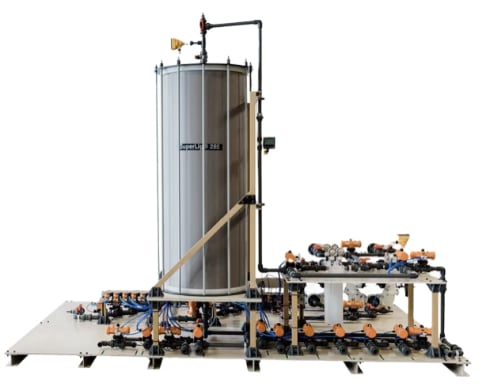
Traditional processes for removing radium from phosphogypsum are highly inefficient. Ion exchange and solvent extraction are not selective for trace radium in a matrix of high calcium. They require multiple stages, create large amounts of waste and have unacceptably low separation efficiencies. IBC’s Molecular Recognition Technology® (MRT®) uses highly selective ligands bonded to a solid support that differentiate metal ions by size, geometry, electron configuration and charge all at once. IBC’s subsidiary RadSep offers MRT® resins that are highly selective for radium down to nanogram-per-liter concentrations in brines, mining streams and nuclear wastes. They retain radium strongly in hydrochloric and nitric acid from 0.01 to 10 molar, and independent studies report radium recovery approaching 100 percent, with less waste and lower cost than other resin-based methods.
Ra-226 is an important precursor material for production pathways used to generate Actinium-225, one of the most promising isotopes for targeted alpha therapy (TAT), which is especially promising for treating advanced, metastatic cancers like prostate cancer. For phosphogypsum, this means that Ra-226 can be efficiently extracted in a one step process using MRT® and used in supply chains supporting targeted alpha therapies for difficult-to-treat cancers.
Left on its own, in contained piles, phosphogypsum is a constant source of radioactive, dangerous radon. If it ever breaks from containment, phosphogypsum contaminates water with radiation, heavy metals, and dangerous acids. Crucially, however, the contained radium could help support production of medical isotopes used in advanced cancer therapies, if extracted cleanly and efficiently with MRT®.
From Radioactive Liability to Industrial Resource
By utilizing MRT® to selectively remove radium and other contaminants, phosphogypsum also has the potential to be transformed from a long-term environmental liability into a valuable industrial resource, thereby turning Florida’s Mountains from a radioactive liability guarded for centuries into a valuable resource for the infrastructure of the future.
Sources:
[1] Ochoa, J. and Newborn, S. (2021). Governor Orders State of Emergency With Massive Piney Point Breach Expected. WUSF Public Media, via WGCU News. Available online at: https://www.wgcu.org/2021-04-04/governor-orders-state-of-emergency-with-massive-piney-point-breach-expected [Accessed 21 Oct. 2026].
[2] Treisman, R. (2021). Crews Drain Florida Wastewater Pond As Leak Threatens To Unleash ‘Catastrophic Flood’. NPR, via KPBS. Available online at: https://www.kpbs.org/news/2021/04/05/crews-drain-florida-wastewater-pond-as-leak [Accessed 21 Oct. 2026].
[3] Callihan, R. and Ballogg, R. (2021). Is a 20-Foot Wall of Contaminated Water Possible in Florida? Bradenton Herald, via Government Technology. Available online at: https://www.govtech.com/em/Is-a-20-Foot-Wall-of-Contaminated-Water-Possible-in-Florida.html [Accessed 21 Oct. 2026].
[4] The New Lede (2024). In Hurricane Milton’s wake, toxic “gypstacks” threaten Tampa Bay area. The New Lede. Available online at: https://www.thenewlede.org/2024/10/in-hurricane-miltons-wake-toxic-gypstacks-threaten-tampa-bay-area/ [Accessed 21 Oct. 2026].
[5] U.S. Environmental Protection Agency (2025). TENORM: Fertilizer and Fertilizer Production Wastes. EPA Radiation Protection. Available online at: https://www.epa.gov/radiation/tenorm-fertilizer-and-fertilizer-production-wastes [Accessed 21 Oct. 2026].
[6] Johnston, A.E. (ed.) (2016). Phosphogypsum: Sustainable Management and Use. International Fertilizer Industry Association, Paris. Available online at: https://www.fertilizer.org/wp-content/uploads/2023/01/2016_IFA_Phosphogypsum_Sustainable_Management.pdf [Accessed 21 Oct. 2026].
[7] Waagmeester, J. (2026). U.S. appeals court approves test of radioactive waste as road paving material. Florida Phoenix. Available online at: https://floridaphoenix.com/2026/08/12/u-s-appeals-court-approves-test-of-radioactive-waste-as-road-paving-material/ [Accessed 21 Oct. 2026].
[8] NPR (2023). Florida lawmakers want to use radioactive material to pave roads. NPR. Available online at: https://www.npr.org/2023/05/09/1174789570/florida-roads-radioactive-paving-phosphogypsum [Accessed 21 Oct. 2026].
[9] U.S. Environmental Protection Agency (n.d.). Radionuclide Basics: Radium. EPA Radiation Protection. Available online at: https://www.epa.gov/radiation/radionuclide-basics-radium [Accessed 21 Oct. 2026].
[10] Polansek, T. (2024). Mosaic says fertilizer waste facility’s water entered Tampa Bay after Hurricane Milton. Reuters, via Canadian Cattlemen. Available online at: https://www.canadiancattlemen.ca/daily/mosaic-says-fertilizer-waste-facilitys-water-entered-tampa-bay-after-hurricane-milton [Accessed 21 Oct. 2026].
[11] Green, A. (2026). A Radioactive Waste Stack Looms Beside a Segregation-Era Community—and It’s Expanding. Inside Climate News. Available online at: https://insideclimatenews.org/news/01082026/florida-radioactive-waste-stack-looms-over-black-residents-near-tampa/ [Accessed 21 Oct. 2026].
[12] Saunders, J. (2025). Mosaic says a lawsuit over its radioactive road project is ‘moot’. News Service of Florida, via WUSF. Available online at: https://www.wusf.org/environment/2025-12-07/mosaic-says-road-fight-moot [Accessed 21 Oct. 2026].
[13] Crangle, R. (2026). Gypsum. Mineral Commodity Summaries 2026, U.S. Geological Survey. Available online at: https://pubs.usgs.gov/periodicals/mcs2026/mcs2026-gypsum.pdf [Accessed 21 Oct. 2026].