

The Race for Lithium Is Really a Race for Purity
Global deployment of lithium-ion batteries in 2025 was six times what it was in 2020, and electric vehicles now account for roughly one in four new cars sold worldwide [1]. Battery chemistries are diverging. Lithium iron phosphate is gaining share, sodium-ion is emerging, and solid-state designs are advancing, but they all still depend on the same essential input: high-purity lithium [2].
Cathode manufacturers do not buy raw brine, and they do not buy dilute lithium chloride. They buy battery-grade lithium hydroxide monohydrate (LiOH·H₂O) or lithium carbonate (Li₂CO₃) at 99.9+% purity, with contaminants such as calcium, magnesium, sodium, potassium, and boron held to a few parts per million [2]. Technology that doesn’t produce lithium to this high level of purity has not made a product; it has made feedstock for someone else’s refinery.
Three approaches now compete to carry lithium from brine to battery: legacy evaporation ponds, direct lithium extraction (DLE), and Direct Lithium to Product® (DLP™), developed by IBC Advanced Technologies. Set side by side, they explain why the next decade of lithium supply will be defined not by who can extract lithium, but by who can deliver finished product at the resource.
Evaporation Ponds: The Slow, Thirsty Incumbent
The traditional route pumps brine into vast, shallow ponds and lets the sun do the work, evaporating water over many months until the lithium is concentrated enough to precipitate and process. The approach is proven but deeply inefficient: only about 30–50% of the brine’s original lithium content is ultimately recovered, while salt tailings and spent chemicals accumulate alongside the ponds [3].
The water toll is heavier still. At Chile’s Salar de Atacama, more than 100 cubic meters of brine are evaporated to produce a single tonne of lithium carbonate equivalent, and the depleted aquifer is not recharged [4]. Land requirements are enormous, supporting a large Atacama-scale operation takes more than 17,000 acres of ponds alone [3], and new pond complexes typically need seven to ten years to reach production [2]. In an era when regulators increasingly reject water-consumptive projects outright, ponds look less like an option and more like a liability [2].
Direct Lithium Extraction: Faster Extraction, Same Old Refinery
Direct lithium extraction is a more modern solution. Instead of waiting on the weather, DLE passes brine through an adsorbent or resin that captures lithium directly, allowing spent brine to be reinjected into the aquifer. As an extraction step it is a real improvement over ponds: faster, smaller, and far less water-intensive [4].
What leaves a DLE circuit is a dilute lithium chloride eluate which typically contains only one to two grams of lithium per liter. This dilute lithium solution must still be concentrated through reverse osmosis and mechanical evaporation, then converted through conventional refining before any battery sees it [2, 4]. Those conversion processes struggle to reach battery-grade quality, and low-purity intermediates are routinely shipped overseas for additional refining [5].
A DLE system advertising 99.6% impurity rejection sounds impressive, but in brines carrying tens of grams of magnesium and calcium per liter, hundreds of parts per million still leak through, yielding a crude intermediate of roughly 62% purity that must be re-refined [2]. Most systems also require substantial upstream pretreatment to strip magnesium, calcium, and boron before the brine ever reaches the adsorbent [2]. Every added stage compounds costs: recovery rates of 70–90% at extraction erode to roughly 63–65% in final product, while cumulative reagent and energy surcharges add $1,000–$1,500 per tonne, amounting to a “refining tax” that forfeits as much as a third of the resource [2]. And because the midstream refinery is its own multi-billion-dollar facility, civil-heavy DLE projects still take four to six years to build, refinery not included [2].
Direct Lithium to Product®
DLP™, built on Molecular Recognition Technology® (MRT™), uses SuperLig® resin which recognizes lithium by its shape and molecular characteristics, not just its charge [2]. The SuperLig® resin extracts roughly 20 times more lithium per unit of media mass, and neither swells nor poisons in harsh brines [2].
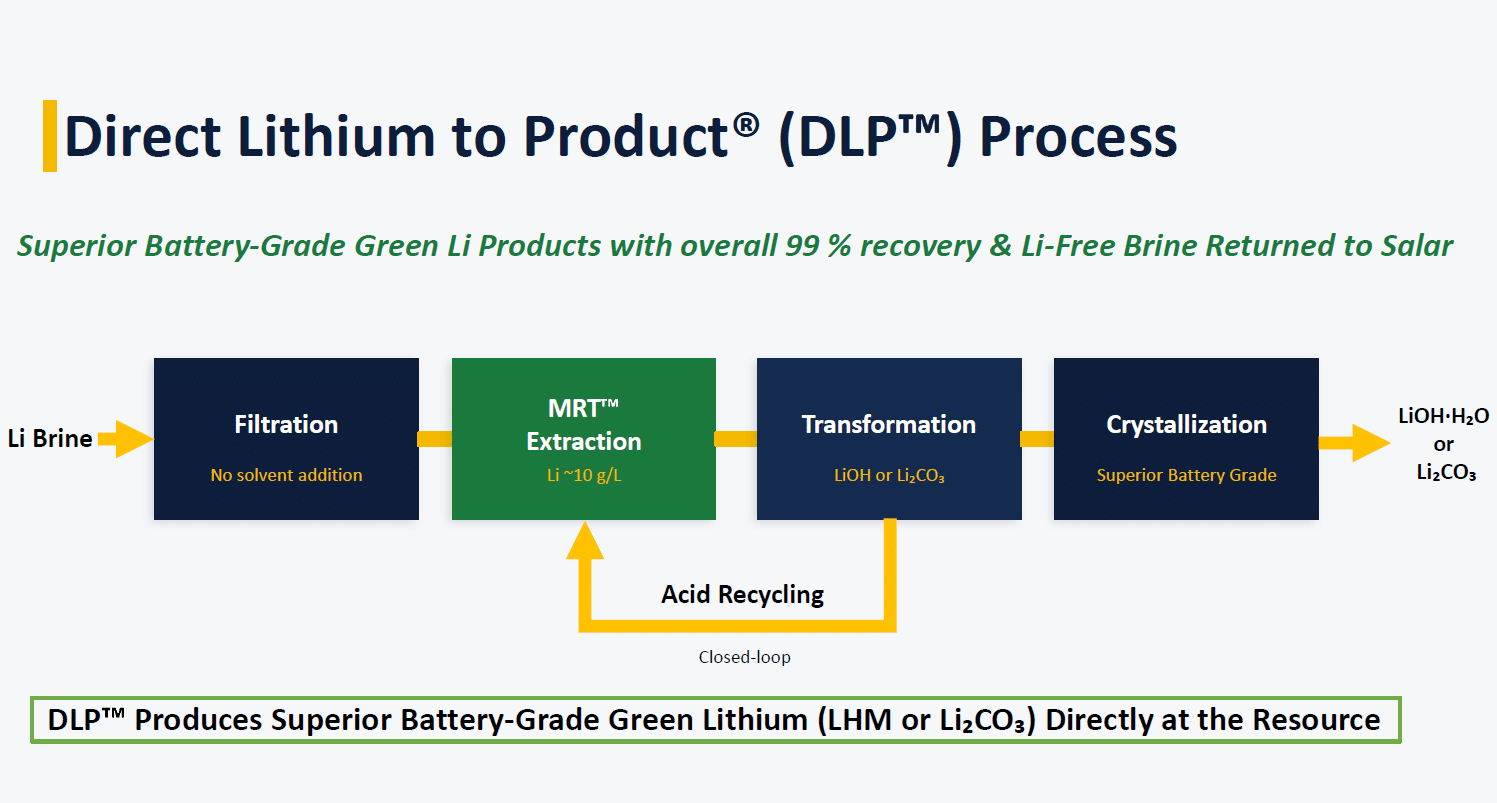
Being so selective gets rid of the need for multiple stages of refinement. Brine flows through extraction with no magnesium, calcium, or boron pretreatment; a concentrated eluate of about 10 g/L Li moves directly to transformation and crystallization; acid is recycled in a closed loop; and lithium-free brine is returned to the salar [2]. No organic solvents, no midstream refinery, no standalone converter. The output is not an intermediate but a finished product: superior battery-grade LiOH·H₂O or Li₂CO₃ at 99.9+% purity, produced on-site in hours to days rather than weeks to months, at 99.1% total recovery [2].
Current field results show that DLP™ returns impressive results. At Maricunga in Chile—one of the world’s most complex brines, whose combined magnesium and calcium content outweighs its lithium more than fifteen-fold—IBC has completed over 70 successful pilot-scale production batches on raw brine, delivering 99.9+% purity LiOH·H₂O independently verified by the Universidad de Atacama, with similar results across more than 30 brines from the Americas, Europe, and Australia [2]. DLP™’s measured impurity rejection (99.998% for magnesium, 99.997% for calcium, and 100% for boron)lands comfortably inside Tier-1 EV OEM limits that DLE intermediates miss by orders of magnitude [2].
The Scoreboard: DLP™ vs. the Field
Lined up side by side, the gap is substantial:
- Recovery: roughly 30–50% for evaporation ponds [3] and about 63–65% net for DLE plus refinery, versus 99.1% for DLP™ [2].
- Purity at the resource: a crude ~62% intermediate for DLE, versus 99.9+% battery-grade product for DLP™ [2].
- Fresh water: 70–110 m³ per tonne for DLE plus refining, versus 10 m³ for DLP™—with 100% of water recycled or returned to source [2].
- Energy and carbon: energy-intensive thermal and chemical processing at ~5.0 kg CO₂ per kg of product, versus 10 kWh/kg and a process-specific carbon-free footprint—73% lower, validated by third-party lifecycle assessments [2].
- Footprint: 50,000+ m² of complex facilities, versus under 5,000 m² of modular equipment [2].
- Capital: roughly 60% lower CAPEX for DLP™, with no pretreatment plant, no refinery, and no multi-facility penalties [2].
Green Chemistry, Water, and the Social License to Operate
DLP™ technology is inherently safer for the environment and workers, as well. Where DLE circuits and their midstream refineries depend on concentrated hydrochloric acid and toxic, flammable organic solvents, DLP™ runs entirely aqueous on dilute, recyclable reagents [2]. That difference cascades through a project’s risk profile with lower insurance premiums, reduced worker exposure, and fewer environmental remediation liabilities, while aligning with the strictest global ESG mandates [2].
DLP™ recycles or returns 100% of its water, sending brine back to the source immediately in its original chemical state, minus the lithium, which protects the aquifers and the communities that depend on them [2]. In jurisdictions where water politics can stall a project longer than engineering ever will, environmental stewardship converts directly into permitting velocity [2].
The Future Isn’t Extraction, It’s Product
The lithium market is moving too fast for seven-year ponds and too demanding for 62% intermediates. Every major battery chemistry still requires high-purity lithium, yet no DLE technology has demonstrated battery-grade product at the resource. DLP™ has proven capable of delivering this valuable commodity at pilot scale, on some of the world’s hardest brines, with independent verification [2]. While DLE makes an intermediary product that requires further refining, DLP™ makes usable product rapidly, at the resource site. And the industry will not scale on intermediates—it will scale on product.
References
[1] International Energy Agency. (2026). Global EV Outlook 2026. https://www.iea.org/reports/global-ev-outlook-2026
[2] Izatt, S. R., (2026). Eliminating the Midstream: Rewriting the Lithium Cost Curve with DLP™. Fastmarkets Global Lithium, Battery & Critical Materials Conference. Las Vegas, NV, USA, June 22-25. https://ibcmrt.com/publications/?publish_paper=C27
[3] SLB. Is it possible to produce high-quality lithium sustainably? https://www.slb.com/resource-library/insights-articles/is-it-possible-to-produce-high-quality-lithium-sustainably
[4] CleanTech Lithium. Direct Lithium Extraction. https://ctlithium.com/about/direct-lithium-extraction/
[5] Mangrove Lithium. Lithium Refining for DLE (Direct Lithium Extractors). https://www.mangrovelithium.com/our-customers/lithium-refining-for-dle/