

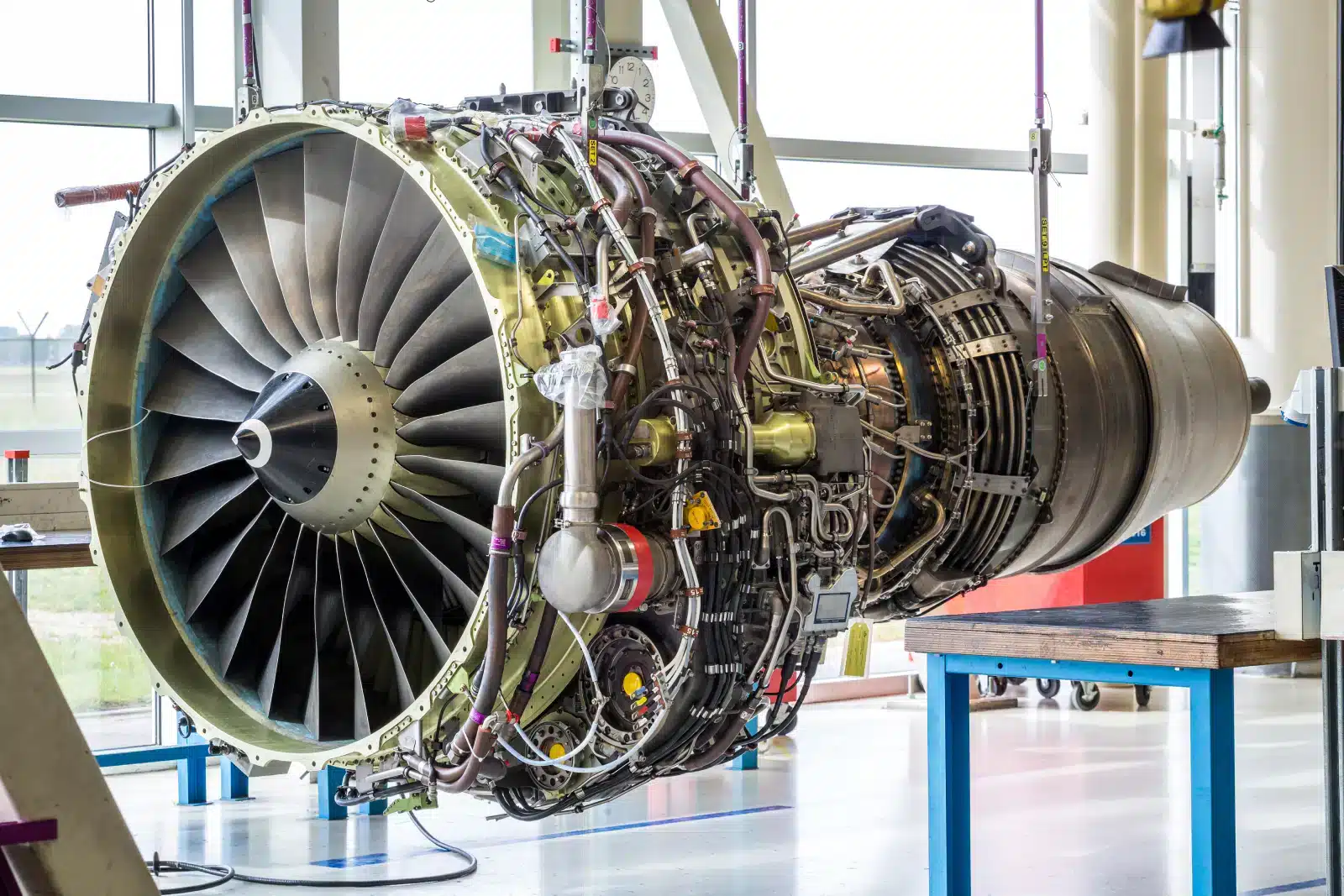
Deep inside the turbine of a modern jet engine, in the first stage just behind the combustor, gas temperatures can exceed 1,650 °C which is hotter than the melting point of the very nickel the engine is built from [5]. Spinning in that inferno are turbine blades, each one cast as a single, unbroken metallic crystal so that no grain boundaries exist for cracks to follow. They must hold their shape under enormous centrifugal load for thousands of hours without deforming. The element that makes this possible is among the rarest on the planet, present at just a few percent by weight: rhenium.
A Metal the World Cannot Easily Replace
Rhenium (Re) is a critical mineral because it anchors systems that define modern industrial capability including jet propulsion, defense, and petroleum refining. Since there are essentially no substitutes in its most important uses, rhenium is included in the U.S. Geological Survey’s official Critical Minerals List [6].
Because of its market fragility, rhenium trades through long-term contracts rather than open exchanges, yet its price still climbed from roughly $2,500 per kilogram at the start of 2025 to well over $6,000 by early 2026 as aerospace demand intensified [3]. The entire annual supply of Re would fit into a few trucks, so even modest demand shifts ripple violently through price.
The Last Naturally Occurring Element to Be Found
When Dmitri Mendeleev built the periodic table in 1871, he left gaps for elements not yet found, including one beneath manganese at atomic number 75 [1]. The slot was filled in 1925, when German chemists Walter Noddack, Ida Tacke, and Otto Berg identified element 75 in platinum ore and rare minerals and named it after the Rhine, Rhenus in Latin, the river of the region Tacke came from [2]. Rhenium was the last naturally occurring element with a stable isotope to be discovered [2].
Ida Tacke’s role is notable: at the time she was the only woman besides Marie Curie credited with discovering an element, and she would later become the first scientist to propose the concept of nuclear fission [8]. Her work also established rhenium’s economic lifeline. In 1929 she extracted a single gram of rhenium from 660 kilograms of molybdenite, demonstrating the link between rhenium and molybdenum [7].
Built for Extremes
Rhenium’s value comes from a remarkable set of physical properties. It melts at about 3,186 °C (the third-highest melting point of any element, behind only tungsten and carbon) and boasts the highest boiling point of all the elements, around 5,596 °C. [10] It is also extraordinarily dense, roughly 21 grams per cubic centimeter, exceeded only by platinum, iridium, and osmium [2]. A silvery-white refractory metal with a hexagonal close-packed structure, it is hard, resists wear and corrosion, and spans an unusually wide range of oxidation states, from −3 to +7 [2, 9]. Finally, rhenium holds its strength and resists creep, the slow deformation of metal under stress at high temperature, far better than most metals.
A Pinch That Changes Everything
About 70 to 85 percent of all rhenium produced goes into high-temperature, nickel-based superalloys for the hottest parts of jet and gas turbines, like blades, vanes, combustion chambers, and nozzles [2, 12]. Added at just a few percent, rhenium slows atomic diffusion within the alloy, slowing creep above 1,000 °C and extending the working life of the part. Second-generation single-crystal alloys contain about 3 percent rhenium and powered the F-15 and F-16; third-generation alloys double that to 6 percent and appear in the F-22 and F-35 [2]. Each new jet engine can require on the order of 50 kilograms of rhenium [12].
The second major use of rhenium is catalytic. Platinum–rhenium catalysts drive the “rheniforming” process that upgrades petroleum naphtha into lead-free, high-octane gasoline [2]. Newer roles are emerging too, from green-hydrogen catalysts to rhenium-based alloys under study for medical implants [4]. In nearly all of these, there is no ready substitute. And rhenium is genuinely scarce: its average abundance in Earth’s continental crust is less than one part per billion, placing it among the rarest elements in nature [1,10].
The “By-Product of a By-Product” Problem
Rhenium almost never occurs as a native metal or its own mineral. Instead, it is found almost exclusively in molybdenite, which is the primary mineral ore of the metal molybdenum. Molybdenum, meanwhile, is itself usually a by-product of copper mining [1,5]. Rhenium is, in the industry’s own phrase, a “by-product of a by-product,” and typical copper–molybdenum concentrates carry only about 50 to 100 grams of it per tonne of material [13].
This makes supply both small and inflexible. Total world production, including recycling, is only around 85 tonnes per year, and roughly half comes from Chile. [5] Because output tracks copper and molybdenum economics rather than rhenium’s own price, producers cannot make more when demand rises; they can only squeeze a little extra from ore they already process [3]. When a large buyer enters the market, prices spike almost immediately [4].
How Rhenium Is Traditionally Refined
When molybdenite concentrate is roasted at around 650–680 °C, the rhenium in it oxidizes to rhenium heptoxide (Re₂O₇), a compound so volatile that it evaporates almost entirely into the furnace’s flue gases. Roughly 80 percent of the world’s rhenium is captured from flue dust [1, 13]. The gases are scrubbed with water, dissolving the rhenium as perrhenic acid, leaving a dilute, impurity-laden solution that must then be concentrated and purified [13].
Conventionally, this purification relies on solvent extraction and ion-exchange resins to separate the trace rhenium from the much larger quantity of molybdenum and other contaminants. The rhenium is then precipitated as ammonium perrhenate, recrystallized, and finally reduced with hydrogen to metal [13]. These methods work, but they are step-heavy, generate substantial waste, and struggle with selectivity: conventional resins and extractants tend to co-load platinum alongside rhenium, because the two elements behave so similarly, complicating high-purity production.
MRT™: A More Selective Route to More Rhenium
This is precisely the kind of separation challenge that IBC Advanced Technologies, Inc. (IBC) addresses with Molecular Recognition Technology® (MRT™). MRT™ uses ligands engineered to recognize a single target ion by its size, geometry, and coordination chemistry, covalently bound to a solid support to form reusable SuperLig® resins that run in simple packed columns. Unlike ion exchange, MRT™ achieves highly selective, single-pass separations using chemically simple eluents at ambient temperature and atmospheric pressure, routinely reaching recoveries above 99% and high purities (99.99 %) while sharply reducing processing steps and waste.
MRT™ has been shown to be an excellent process for recovery and purification of rhenium from secondary and primary sources. A full-scale commercial SuperLig® 188 MRT™ plant dedicated to recycling rhenium from the superalloy turbine blades of retired jet engines has been described. From a feed containing less than one gram of rhenium per liter, the MRT™ system selectively binds perrhenate ion (ReO4–) and releases it as a concentrated perrhenate solution exceeding ten grams per liter rhenium. Well over 99% of the rhenium is recovered at better than 99.99% purity [13]. In separate work with Rio Tinto Kennecott, the same SuperLig® 188 resin pulled rhenium from an arsenic-laden stream, binding it at room temperature and eluting it with nothing more exotic than deionized water [14]. Due to its high selectivity, MRT™ yields a cleaner rhenium product in fewer steps.
Recycling is one of the few levers that can actually expand rhenium supply. Primary production is locked to copper and molybdenum mining, but every retired turbine blade and spent catalyst is a concentrated, above-ground reserve of an element otherwise vanishingly rare in the earth. By recovering rhenium selectively, cleanly, and at high yield, MRT™ helps turn that scrap into a valuable secondary source.
Sources
- David A. John, Rhenium—A Rare Metal Critical to Modern Transportation (April 2015). https://www.usgs.gov/centers/national-minerals-information-center/rhenium-statistics-and-information
- Royal Society of Chemistry. Rhenium. https://periodic-table.rsc.org/element/75/rhenium
- Strategic Metals Invest, Rhenium Price. https://strategicmetalsinvest.com/rhenium-prices/
- Quest Metals, Rhenium Surge, (October 2025) https://www.questmetals.com/blog/rhenium-surge
- Lee S. Langston, Each Blade a Single Crystal, (January 2015) https://www.americanscientist.org/article/each-blade-a-single-crystal
- Tim T. Werner, Gavin M. Mudd, Simon M. Jowitt & David Huston, Rhenium Mineral Resources: A Global Assessment, (March 2023) https://www.sciencedirect.com/science/article/pii/S0301420723001496 ; https://link.springer.com/article/10.1007/s13563-023-00392-0
- Lipmann Walton & Co., A Celebration of 99 yrs Rhenium!, (October 2024) https://www.lipmann.co.uk/post/a-celebration-of-99-yrs-rhenium
- U.S. Women in Nuclear, Women in Nuclear History Series #11 – Ida Noddack, (February 2025) https://www.britannica.com/biography/Ida-Noddack
- KGHM, Rhenium https://kghm.com/en/our-business/products/rhenium
- ScienceDirect Topics, Rhenium – An Overview https://www.sciencedirect.com/topics/earth-and-planetary-sciences/rhenium
- EarthRarest, Invest in Rhenium, (March 2025) https://earthrarest.com/rhenium/
- H.S. Kim, J.S. Park, S.Y. Seo, T. Tran & M.J. Kim, Recovery of Rhenium from a Molybdenite Roaster Fume as High-Purity Ammonium Perrhenate, (June 2015) https://www.sciencedirect.com/science/article/abs/pii/S0304386X15300323
- Izatt, S.R., Bruening, R.L., Izatt, N.E., Izatt, R.M. (2018). Green Chemistry Principles Applied to the Selective Separation and Purification of Specialty Metals Using Molecular Recognition Technology. Extraction 2018, Gordon Ritcey Symposium: Advances in Hydrometallurgical Solution Purification Separations, Ottawa, Ontario, Canada, August 26-29
- Wang, S. et al. (2019). Recovery of Value-Added Metals from Copper Refining Streams using Molecular Recognition Technology. Copper Cu2019 Conference, Vancouver, Canada, August 18-21