

From Cu-64 to Pb-203: Solving the Purification Challenge in Medical Radioisotopes
Nuclear medicine uses radioactive isotopes to diagnose and treat disease, and it is routine at hospitals and health care facilities worldwide, spanning everything from positron emission tomography (PET) scans that diagnose Alzheimer’s disease to radiopharmaceuticals that treat cancer [1]. On the diagnostic side, the instrument is the radiotracer: a radionuclide attached to a carrier molecule that delivers it to a specific target in the body, where its emissions can be assembled into a three-dimensional image by PET or by single photon emission computed tomography (SPECT) [1]. For that image to be reliable for diagnosis and safe to use, the radioisotope must be pure and it must be securely attached to the appropriate carrier molecule through radiolabeling [1]. In this article, we will discuss three diagnostic radioisotopes: copper-64 (Cu-64), gallium-68 (Ga-68) and lead-203 (Pb-203).
Three Isotopes, Three Diagnostic Jobs
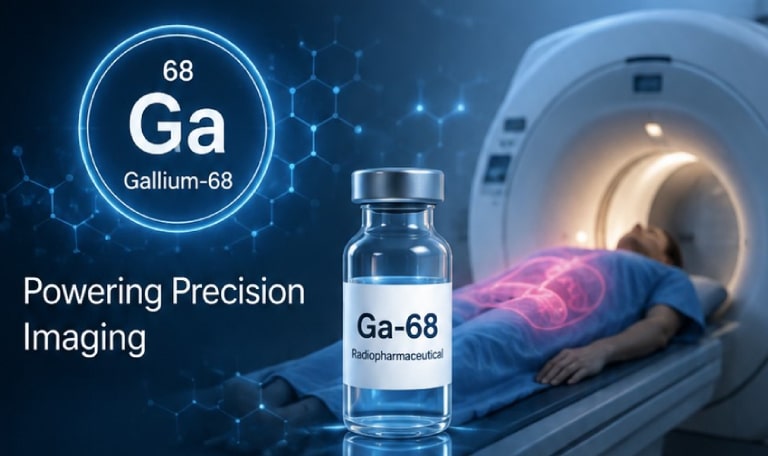
Ga-68 is the most widely used of the three. It has a half-life of 68 minutes and decays 89 percent by positron emission, making it a natural PET emitter, and it is obtained from a germanium-68 parent with a half-life of 270.8 days that can be eluted on demand from a generator [2]. Its clinical footprint is substantial. On December 1, 2020, the U.S. Food and Drug Administration approved Ga-68 PSMA-11, the first drug for PET imaging of prostate-specific membrane antigen-positive lesions in men with prostate cancer, under new drug applications submitted by UCLA and UCSF [3]. As useful as Ga-68 is, the 68-minute half life-clock is also constraining: the isotope cannot be transported far, and a commercial generator yields only enough activity for roughly three patient doses per synthesis run when new, falling to about two after a year and eventually to one [4]. After some 400 elutions the generator itself becomes long-lived radioactive waste requiring disposal, and germanium-68 breakthrough into the final product remains a standing risk [4].
Cu-64 is logistically completely different, because its physical half-life of 12.7 hours is long enough that the finished drug can be manufactured centrally and shipped. This longer half life makes Cu-64 valuable for use in slower-clearing carriers such as antibodies, where the majority of an isotope with a 68-minute half-life will decay long before the tracer has found its target. A significant use of Cu-64 is in detecting neuroendocrine tumors, which are small and slow growing, making them extremely difficult to locate. While Cu-64 is used for imaging, it can be paired with the beta-emitter Cu-67 for therapeutic treatments. This theranostic pair of radioisotopes is useful because they will exhibit identical chemical behavior for binding and clearing from organs, allowing medical professionals to use C-67 to treat the same tissue they visualized with Cu-64.
Pb-203 is the newest of the three and, in one respect, the most interesting. It has a half-life of 51.9 hours and decays by electron capture to stable thallium-203 [6]. Its significance is that, when combined with therapeutic alpha-emitter lead-212 (Pb-212), the combination is the only elementally identical theranostic pair currently available for alpha-therapy[6]. This means that the two molecules are similar enough to use the same carrier molecule, and after Pb-203 locates problematic cancer cells, Pb-212 is able to immediately target the same cells with perfect accuracy.
Purity: The Rate-limiting Step
Each radionuclide is produced within a target matrix containing overwhelming amounts of other elements that must be removed before clinical use. For Cu-64, cyclotron irradiation of zinc targets requires not only careful control to achieve high radionuclidic purity but also complex chemical processing to separate trace amounts of copper from bulk zinc and gallium co-products. Traditionally, this involves solvent extraction of copper dithizonate, back-extraction into the aqueous phase, removal of gallium with isopropyl ether, and final purification by anion-exchange chromatography [8]. Similarly, Pb-203 is produced by cyclotron irradiation of enriched thallium-205, requiring the isolation of minute quantities of lead from a large excess of thallium. This is typically achieved through multiple cation- and anion-exchange chromatography steps using hydrochloric, nitric, hydrobromic acid, and hydrochloric acid-acetone mixtures to reduce residual thallium to clinically acceptable levels below 0.1 μg [9].
Ga-68 production presents a different but equally important challenge. Rather than being limited primarily by chemical separation from the target material, conventional production depends on germanium-68/gallium-68 generators, which have limited elution capacity and struggle to meet the demand for multiple patient doses because of Ga-68’s short physical half-life. Furthermore, the generator eluate contains metallic impurities, including aluminium, iron, natural gallium, titanium, zinc, and lead, at concentrations that often exceed those of the starting eluent. These trivalent and tetravalent metal ions compete directly with Ga³⁺ for radiolabelling chelators, reducing radiochemical yields unless additional purification steps are performed [10]. Together, these production and purification challenges increase processing time, complexity, and cost, making recovery of used radionuclides very attractive.
The RadSep Solution: Single-Step Purification
RadSep, Inc. is a subsidiary of IBC Advanced Technologies, Inc., founded in the United States in 1988, with decades of experience designing, manufacturing and installing Molecular Recognition Technology® (MRT™) products and systems for customers worldwide [14]. MRT™ resins to purify Ga-68, Cu-64, Pb-203 and other radioisotopes for imaging are readily available [1].
MRT™ resins rapidly recover the desired element at up to 99.99 percent purity and 99.9+ percent first-pass yield, with exceptional selectivity for the individual radioisotope, high capacity and rapid bind-and-release kinetics that produce a pure, concentrated product, and the potential for single-step recovery that collapses a multi-stage flowsheet into one [12,13]. Their chemical and radiolytic stability (up to 1.0E+9 Rad) allows the resins to be reused across many cycles, minimizing the waste that conventional separation methods generate [13]. For lead specifically, RadSep developed an MRT™ resin highly selective for lead that achieves 99.99 percent purity and 99.9+ percent recovery, built to separate lead-212 rapidly from the other daughters in its decay chain, including radium-224 [13].
Purification, however, is only half the problem, as being securely attached to a targeting molecule is what makes pure isotopes useable. RadSep specializes in synthesizing custom chelating agents with very high selectivity coefficients and exceptional binding constants and has the capability to develop and manufacture chelators that are more stable and effective in vivo than common agents such as DOTA, DOTEM and TCMC. [1].
RadSep vs. Traditional Separation: Why It Wins
Conventional separations reach high purity only with protracted processing: ion exchange and solvent extraction typically require multiple stages to achieve 99+ percent purities, whereas MRT™ can purify and concentrate in a simple, single-stage process [13]. Ion exchange resins are also less durable under radiation, so they generate more waste and require more frequent replacement than MRT™ resins [12]. For Theragenics, which uses MRT™ in Pd-103 brachytherapy seed manufacturing, the simplified flowsheet that eliminates steps, reagents and waste production inherent in other separation processes is highly valuable [1].
The supply of medical radionuclides is extremely constrained, which makes it essential to preserve these scarce resources by recovering them efficiently. For diagnostics, the stakes are cumulative: purity determines what a clinician can see, and with matched pairs like Pb-203/Pb-212 and Cu-64/Cu-67, what a clinician can see increasingly determines what they can treat.
Sources
[1] About Nuclear Medicine and Radiopharmaceuticals. RadSep, Inc. https://radioisotopeseparations.com/about-nuclear-medicine-and-radiopharmaceuticals/
[2] Gallium 68 – an overview. ScienceDirect Topics. https://www.sciencedirect.com/topics/medicine-and-dentistry/gallium-68
[3] Hennrich, U., Eder, M. [68Ga]Ga-PSMA-11: The First FDA-Approved 68Ga-Radiopharmaceutical for PET Imaging of Prostate Cancer. Pharmaceuticals, 2021. https://www.ncbi.nlm.nih.gov/pmc/articles/PMC8401928/ ; FDA Approves Gallium 68 PSMA-11 as PET-Imaging Drug for Prostate Cancer. OncLive, December 2020. https://www.onclive.com/view/fda-approves-gallium-68-psma-11-as-pet-imaging-drug-for-prostate-cancer
[4] Alnahwi, A. H., Tremblay, S., Guérin, B., et al. Multi-curie production of gallium-68 on a biomedical cyclotron and automated radiolabelling of PSMA-11 and DOTATATE. EJNMMI Radiopharmacy and Chemistry, 2020. https://pmc.ncbi.nlm.nih.gov/articles/PMC7790954/
[5] FDA Approves Copper Cu 64 Dotatate Injection for Somatostatin Receptor-Positive NETs. OncLive, 2020. https://www.onclive.com/view/fda-approves-copper-cu-64-dotatate-injection-for-somatostatin-receptor-positive-nets
[6] Lead radionuclides for theranostic applications in nuclear medicine: from atom to bedside. PubMed Central. https://pmc.ncbi.nlm.nih.gov/articles/PMC12775822/
[7] Santos, J. C., et al. 203/212Pb theranostic radiopharmaceuticals for image-guided radionuclide therapy for cancer. PubMed Central. https://pmc.ncbi.nlm.nih.gov/articles/PMC10613023/
[8] The production and isolation of Cu-64 and Cu-67 from zinc target material and other radionuclides. Czechoslovak Journal of Physics. https://link.springer.com/article/10.1007/s10582-006-1063-9
[9] Separation of lead-203 from cyclotron-bombarded thallium targets by ion-exchange chromatography. PubMed. https://pubmed.ncbi.nlm.nih.gov/18963189/
[10] Young, J. D., et al. The effects of trace metal impurities on Ga-68-radiolabelling with a tris(3-hydroxy-1,6-dimethylpyridin-4-one) (THP) chelator. EJNMMI Radiopharmacy and Chemistry, 2022. https://pmc.ncbi.nlm.nih.gov/articles/PMC9075519/
[12] Products. RadSep, Inc. https://radioisotopeseparations.com/products/
[13] Radioisotope Separations Technology. RadSep, Inc. https://radioisotopeseparations.com/radioisotope-separations-technology/
[14] About RadSep, Inc. RadSep, Inc. https://radioisotopeseparations.com/about-radsep-inc/