

Two Scarce Metals the Energy Transition Depends On
Iridium (Ir) and ruthenium (Ru) are the two least abundant members of the platinum group metals (PGMs), a classification defined by scarcity. Roughly 7.5 tonnes of Ir are mined each year, compared with about 200 tonnes of platinum, and South Africa accounts for 88% of that Ir supply [1]. Ru is less concentrated, with more than 85% of primary supply also originating in South Africa [2]. Ruthenium and Iridium are designated as critical and strategic materials by the European Union, the United States, Canada, and South Africa under their classification as PGMs [2, 3, 4, 5]. Similarly, Japan’s Ministry of Economy, Trade and Industry (METI) classifies the Platinum Group Metals (PGMs) group as a vital critical material category subject to national stockpiling and supply-chain diversification policies [6].
Demand for these metals continues to rise. Market reports put Ir demand at 240,000 troy ounces, a three-year high, against flat primary supply of 229,000 troy ounces, leaving a deficit of roughly 11,000 ounces [7]. Electrochemical applications alone account for 109,000 ounces as the first large proton exchange membrane (PEM) electrolyzer projects in Europe near completion, and Ir is effectively irreplaceable in the anode catalyst layer of a PEM membrane electrode assembly, which makes it a constraining factor for green hydrogen. The price for Ir sat at an all-time high of $8,000 per troy ounce in the first quarter of 2026 [7].
Ruthenium’s position is even more constrained. Demand in 2025 reached 1,265,000 ounces against primary supply of 972,000 ounces, a deficit of 293,000 ounces, or almost a quarter of annual consumption [7]. Chemical catalysis, hard disk drives for data centers, chip resistor pastes, and electrochemical electrodes use Ru, and Chinese export controls introduced in February 2025 tightened availability elsewhere [7]. Ru set its own record of $1,750 per ounce in early 2026 [7]. When metals are this scarce, how efficiently they can be separated and refined becomes a critical part of bolstering supply.
Why Iridium and Ruthenium Are the Hardest PGMs to Refine
Platinum group metal refining is sequential. Metals come out of a chloride leach solution one at a time, and Ir and Ru are typically left until the end, after platinum, palladium, and rhodium. Both metals present distinct challenges for recovery.
Iridium’s problem is that it reacts only reluctantly. In refinery solutions, Ir typically comes in the form of a chloride complex called hexachloroiridate(III), or [IrCl6]3- [8]. This complex is an iridium atom wrapped in an extremely stable shell of six chlorine atoms [8]. The usual way to recover a dissolved metal is reduction, giving it back the electrons it lost so that it drops out of solution as a solid. With iridium, that reaction runs so slowly it is barely useful [8]. Refiners have had to work around this kinetic bottleneck by intentionally oxidizing the solution to convert it to hexachloroiridate(IV), or [IrCl6]2- [8, 9]. They then add ammonium chloride (NH4Cl) to force the iridium to precipitate out of the liquid as an insoluble dark red-black salt, bypassing direct metal reduction entirely [8, 9].
Iridium also shifts back and forth between two forms, Ir(III) and Ir(IV), depending on conditions, so a batch of feed is rarely one clean, predictable substance [8, 9]. On top of that, the chloride complexes Ir forms closely resemble the ones rhodium forms, in size, shape, and charge [8]. To most separation methods, the two metals look nearly identical, which makes pulling them apart extremely difficult [8].
Traditional ruthenium (Ru) refining can be effective but is highly noxious and energy intensive [10]. In the form of ruthenium tetroxide (RuO4), ruthenium evaporates readily at ordinary temperatures, with a vapor pressure of roughly 10 mmHg at 25 °C [10]. Refiners deliberately convert Ru into that compound and boil it out of the solution as a gas, then capture it downstream [10]. However, the conversion process involves dissolving the feed into hot, concentrated hydrochloric acid, with chlorine gas bubbled through it at 65 to 98 °C [11]. The distillation step can generate explosive chlorine oxides, and the driven-off RuO4 is highly toxic [11]. The whole plant requires sealed, specialized equipment and continuous monitoring [11].
Why Classical PGM Separation Technology Falls Short
The three most common separation technologies used in PGM refining struggle to efficiently separate and process Ir and Ru. Precipitation is the least effective, offering poor selectivity between chemically similar ions. Solvent extraction depends on flammable, harsh organic solvents and the fire, ventilation, and disposal burdens they bring. Ion exchange delivers poor first-pass recoveries and requires extensive secondary processing to reach saleable purity.
The underlying reason is that all three recognize a metal ion by just a single parameter: precipitation by solubility, ion exchange by charge, solvent extraction by partitioning behavior [12]. The consequences are long flowsheets, repeated recycle loops, and large volumes of metal-bearing inventory going through a very time-consuming process, which is expensive when the metal trades at thousands of dollars an ounce. Solvent extraction and ion exchange also demand more dilute solutions than precipitation, producing higher solution volumes and more evaporation stages [11].
How MRT™ Outperforms Traditional Methods
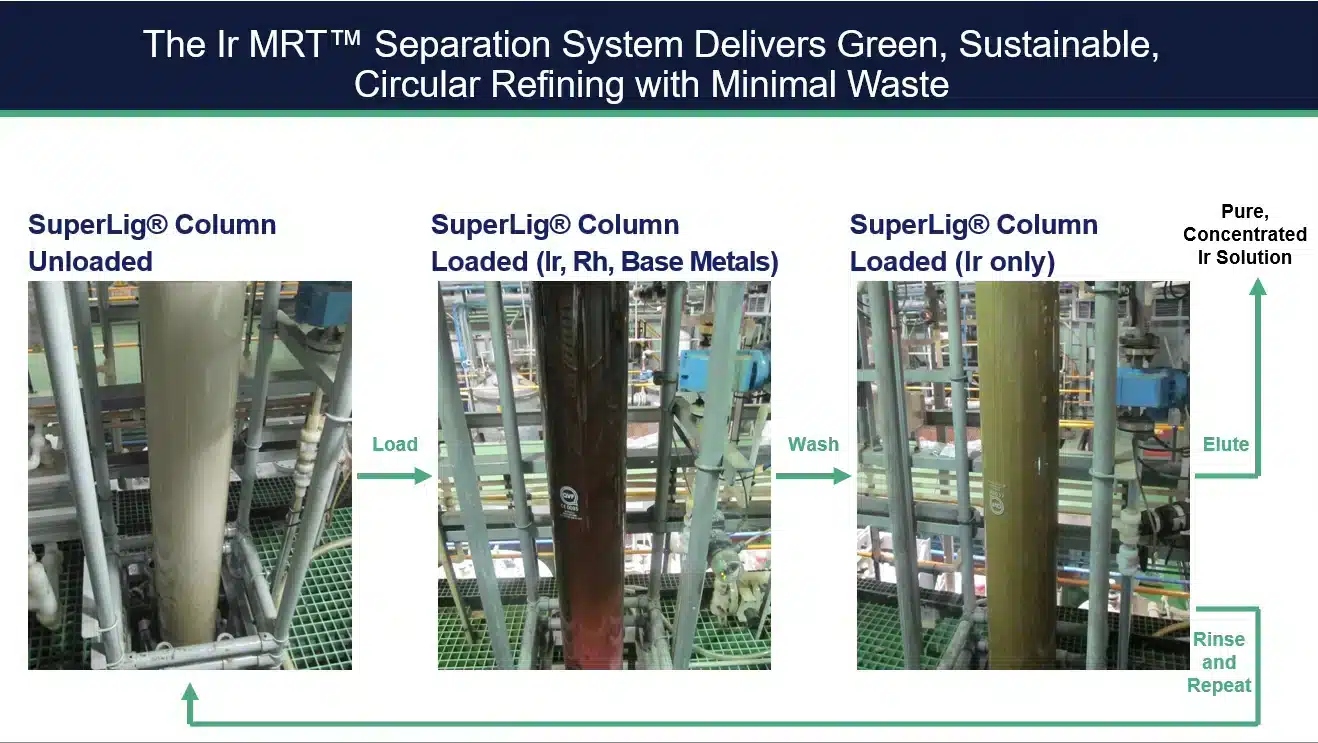
MRT™ uses a ligand designed for a specific target ion and covalently bonded to a solid support such as silica gel or a polymer bead, sold as SuperLig® resin. Rather than recognizing just one characteristic, the ligand binds the way a lock accepts a key, discriminating on the basis of ionic size, coordination chemistry, donor atom type and number, and geometry all at once [12]. This results in binding strength conventional ion exchange cannot match: apparent log K values for SuperLig® resins have been reported at 17.0 for Ni²⁺ and 22.0 for Cu²⁺, against values below 0.7 for ion exchange materials [12].
An MRT™ cycle runs in four steps [12]:
Loading: the feed solution passes through a packed SuperLig® column, and the target metal is selectively extracted by the SuperLig® resin.
Pre-elution wash: the residual feed solution is displaced from the column.
Elution: the bound metal is released completely, typically into one to two bed volumes of eluent, producing a concentrated, high-purity solution.
Post-elution wash: the remaining eluent is rinsed out, and the column returns to the loading step.
Iridium and Ruthenium Separations in Practice
MRT™ separates all five platinum group metals individually, including Ir and Ru. For Ir, MRT™ is efficient and highly selective over rhodium, addressing the separation traditional routes handle poorly using complicated flowsheets with harsh chemicals, organic solvents and a large amount of energy [13].
At Sibanye-Stillwater’s South African Precious Metals Refinery, an MRT™ system has separated Ir from rhodium and other PGMs in primary ore feed since 2015 and now processes a substantial portion of the world’s Ir, using a simple flowsheet with minimal waste and a negligible carbon footprint [14].
IBC has been selected by Isondo Precious Metals (IPM) to supply MRT™ systems for recycling platinum group metals, both from IPM’s own manufacturing operations and from spent secondary materials such as autocatalytic converters and other concentrate feedstocks. Test work on IPM surrogate feeds has demonstrated predictable, repeatable, commercially viable recovery at catalyst-grade purity, operating at room temperature using water, dilute HCl, NaCl, and KCl [15].
Across these applications, MRT™ systems have demonstrated the application of green chemistry and green engineering to achieve complex separations characterized by:
Simplicity: purification in a single-stage process, eliminating the time, space and equipment needed for secondary processing
High Selectivity: elution in very few bed volumes as a pure, concentrated solution which reduces reagent and energy consumption
Sustainability and Circularity: operation using modular, automated systems with low energy intensity, no solvents or harsh chemicals and minimal waste
Efficiency: reduction of metal hold-up and processing time due to rapid kinetics and high first pass yields
Refining as a Critical Supply Strategy
Both Ir and Ru are in a chronic supply deficit and, as by-products of platinum mining, their supply cannot be easily increased by mining alone. Instead, making the refining process as productive as possible using secondary sources is imperative. Every troy ounce of Ir or Ru that is not recovered efficiently, lost to a recycling loop, or tied up as in-process inventory is metal not reaching the market, and lost income. The molecular-level selectivity MRT™ provides significantly improves the economics of Ir and Ru refining.
MRT™ has been applied at industrial scale to platinum group metal separations for over three decades. Its use of green chemistry and green engineering, minimal waste, low reagent consumption, and small footprint is documented across primary and secondary feedstocks [14, 16]. As PEM electrolyzers, data center storage, and chemical catalysis compete for an essential metal supply that is not growing, separating and refining Ir and Ru cleanly from whatever matrix they arrive in becomes a consequential piece of infrastructure in the critical minerals economy.
Sources:
[1] RMIS – Raw Materials Information System. (2026). RMIS – Raw materials profiles. Available at: https://rmis.jrc.ec.europa.eu/rmp/Iridium [Accessed 31 Aug. 2026].
[2] Federal Register. (2025). Final 2025 List of Critical Minerals. [online] Available at: https://www.federalregister.gov/documents/2025/11/07/2025-19813/final-2025-list-of-critical-minerals [Accessed 31 Aug. 2026].
[3] European Commission (2023). Critical raw materials. [online] single-market-economy.ec.europa.eu. Available at: https://single-market-economy.ec.europa.eu/sectors/raw-materials/areas-specific-interest/critical-raw-materials_en [Accessed 31 Aug. 2026].
[4] Natural Resources Canada (2022). Critical minerals: an opportunity for Canada. [online] www.canada.ca. Available at: https://www.canada.ca/en/campaign/critical-minerals-in-canada/critical-minerals-an-opportunity-for-canada.html [Accessed 31 Aug. 2026].
[5] www.sgu.se. (n.d.). Critical raw materials. [online] Available at: https://www.sgu.se/en/mineral-resources/critical-raw-materials/ [Accessed 31 Aug. 2026].
[6] IEA. (n.d.). International Resource Strategy – National stockpiling system – Policies. [online] Available at: https://www.iea.org/policies/16639-international-resource-strategy-national-stockpiling-system [Accessed 1 Sept. 2026].
[7] Cowley, A. (2026). PGM market report. Johnson Mathey PLC. Available at: https://matthey.com/documents/161599/509428/pgm-market-report-26.pdf/a2d115af-bf7c-f589-29e9-6beacf8a4452?t=1778750383760
[8] Crundwell, F., Moats, M.S., Venkoba Ramachandran and Al, E. (2011). Extractive metallurgy of nickel, cobalt and platinum group metals. Elsevier. doi:10.1016/c2009-0-63541-8.
[9] Yoshimura, A., Komatsuda, H. and Matsuno, Y. (2024). Establishment of a Novel Recycling Process for Iridium Using “Dry Aqua Regia.” MATERIALS TRANSACTIONS, 65(1), pp.49–53. doi:10.2320/matertrans.mt-m2023084.
[10] Iron, Ruthenium and Osmium. (1997). Chemistry of the Elements, pp.1070–1112. doi:10.1016/b978-0-7506-3365-9.50031-6.
[11] Rudnik, E. (2026). Reclaiming Ruthenium: A Comprehensive Review of Hydrometallurgical Strategies for Precious Metal Recovery. Materials, 19(3), p.461. doi:10.3390/ma19030461.
[12] IBC Advanced Technologies. Highly Selective Separations: SuperLig®, MRT™ Systems. https://ibcmrt.com/products-processes-and-services/highly-selective-separations-superlig/. [Accessed August 31, 2026]
[13] Minh Nhan Le, Man Seung Lee and Gamini Senanayake (2018). A Short Review of the Separation of Iridium and Rhodium from Hydrochloric Acid Solutions by Solvent Extraction. Journal of Solution Chemistry, 47(8), pp.1373–1394. doi:10.1007/s10953-018-0770-8.
[14] Izatt, S. R., Izatt, R. M., Bruening, R. L., Krakowiak, K. E., & Navarro, L. G. (2023). Highly selective separations by MRT™ (Molecular Recognition Technology™) – Review of individual separations of palladium, platinum, rhodium, iridium, and ruthenium from industrial feedstocks and comparison with classical PGM separation processes. IPMI Journal, 4. Available at: https://www.researchgate.net/publication/380375723_Highly_Selective_Separations_by_MRT_Molecular_Recognition_Technology_-_Review_of_Individual_Separations_of_Palladium_Platinum_Rhodium_Iridium_and_Ruthenium_from_Industrial_Feedstocks_and_Comparison_wi
[15] Izatt, S.R., Somera, V. (2026, June 6-9). The Refining of Iridium and Rhodium using Molecular Recognition Technology® (MRT™) [Conference presentation]. IPMI 50th Annual Conference, Orlando Florida, United States. Available upon request at: https://ibcmrt.com/publications/?publish_paper=B44
[16] Izatt, R.M., Izatt, S.R., Izatt, N.E., Krakowiak, K.E., Bruening, R.L. and Navarro, L. (2015). Industrial applications of molecular recognition technology to separations of platinum group metals and selective removal of metal impurities from process streams. Green Chemistry, 17(4), pp.2236–2245. doi:10.1039/C4GC02188F.