

The Long Legacy of Lead Mining
Lead is one of the most anciently worked metals. Evidence near present-day Turkey suggests lead smelting as early as the 7th century BC, possibly representing one of the earliest metal smelting sites. Over time, the myriad uses for lead expanded and its mining and use reached a peak during the Roman Empire. Following the fall of Rome, its use stagnated until large scale industrialization began in Britain in the 1700s. With the onset of industrialization, lead production and consumption surged. It became a common additive in everyday materials, from paint and petrol to plumbing and metal alloys. Britain dominated global lead production from the early Industrial Revolution through the mid-19th century, before output declined as richer deposits were discovered overseas. By the 1930s, domestic lead mining was virtually non-existent. [1] Yet its environmental footprint remains firmly in place. This early mechanization enriched Britain but has also embedded widespread environmental contamination.
Abandoned Mines and Persistent Water Contamination
Across Britain, thousands of abandoned lead mines still dot the landscape. Beneath the surface, networks of tunnels continue to channel contaminated groundwater into rivers, sustaining a persistent source of pollution. [2] Efforts to address this problem have been slow and complicated by outdated laws. Prior to 2000, private companies holding mining rights often carried no legal liability for the long-term water pollution caused by abandoned mines. As a result, decades of unchecked contamination accumulated with little intervention. In response, the UK government launched the Water and Abandoned Metal Mines (WAMM) Program in 2011. However, progress to halt pollution into groundwater has been limited. Investigations have found that in Wales, for example, only a small fraction of polluted sites have been meaningfully addressed. Environmental authorities such as Natural Resources Wales and the Coal Authority face constraints in both funding and remit, often focusing narrowly on mine sites while contamination continues to affect surrounding communities. [3]
Health Impacts of Lead Exposure
The consequences are significant. Lead exposure is linked to a wide range of health problems, particularly neurological impairment, as well as damage to the kidneys and cardiovascular system. Globally, it is associated with an estimated 900,000 premature deaths each year. [4] There is no known safe level of exposure. In Britain, acute poisoning is uncommon, but chronic, low-level exposure remains a concern. Symptoms can be subtle—fatigue, abdominal pain—but may also include more distinctive signs such as Burton’s line, a bluish discoloration along the gums. [5]
The story of lead poisoning in Britain is one of legacy pollution. The industrialization that enriched the nation and was eased by permissive legislation toward private mining companies has had uncontrollable knock-on effects: Lead contamination in water and soil is often impossible to detect without specialized equipment. The legacy of lead is widespread. Around 1 in 3 children – up to 800 million globally – has blood lead levels at or above 5 micrograms per deciliter (µg/dL), a level that the World Health Organization and the United States Centers for Disease Control and Prevention have stated requires global and regional interventions. [6]
Why Traditional Lead Removal Technologies Struggle
Once absorbed, lead exposure is extremely difficult to treat, and so avoidance is paramount. [7] Preventing contamination directly at abandoned mine sites is technically difficult and often extremely expensive. Instead, using filters at the source of use, in people’s homes or at municipal water treatment facilities would be the most effective way to eliminate lead from the water used.
Selective Lead Removal Using Molecular Recognition Technology® (MRT™)
Removing dissolved lead from contaminated water streams is challenging because it often occurs at very low concentrations and in the presence of other dissolved metals with similar chemical behavior. Conventional technologies such as precipitation, membrane filtration, solvent extraction, or ion exchange frequently require multiple processing steps and large volumes of chemicals. These approaches can generate additional waste streams and struggle to selectively separate lead from complex mixtures of metals.
Molecular Recognition Technology® (MRT™) offers a fundamentally different approach. MRT™ uses predesigned metal-selective ligands attached by chemical binding through a tether to solid supports, such as silica gel or polymer substrates. Resulting products, termed SuperLig® resins, operate at nanometer scale. The controlled, highly selective separations that occur at the molecular level are an example of nanochemistry being used in a novel way to demonstrate supramolecular host–guest assembly. Organic solvents are not used in these MRT™ systems. [7] The ligands are engineered to recognize specific ionic size, charge, and coordination chemistry, enabling extremely high selectivity for the desired metal even when competing ions are present at much higher concentrations.
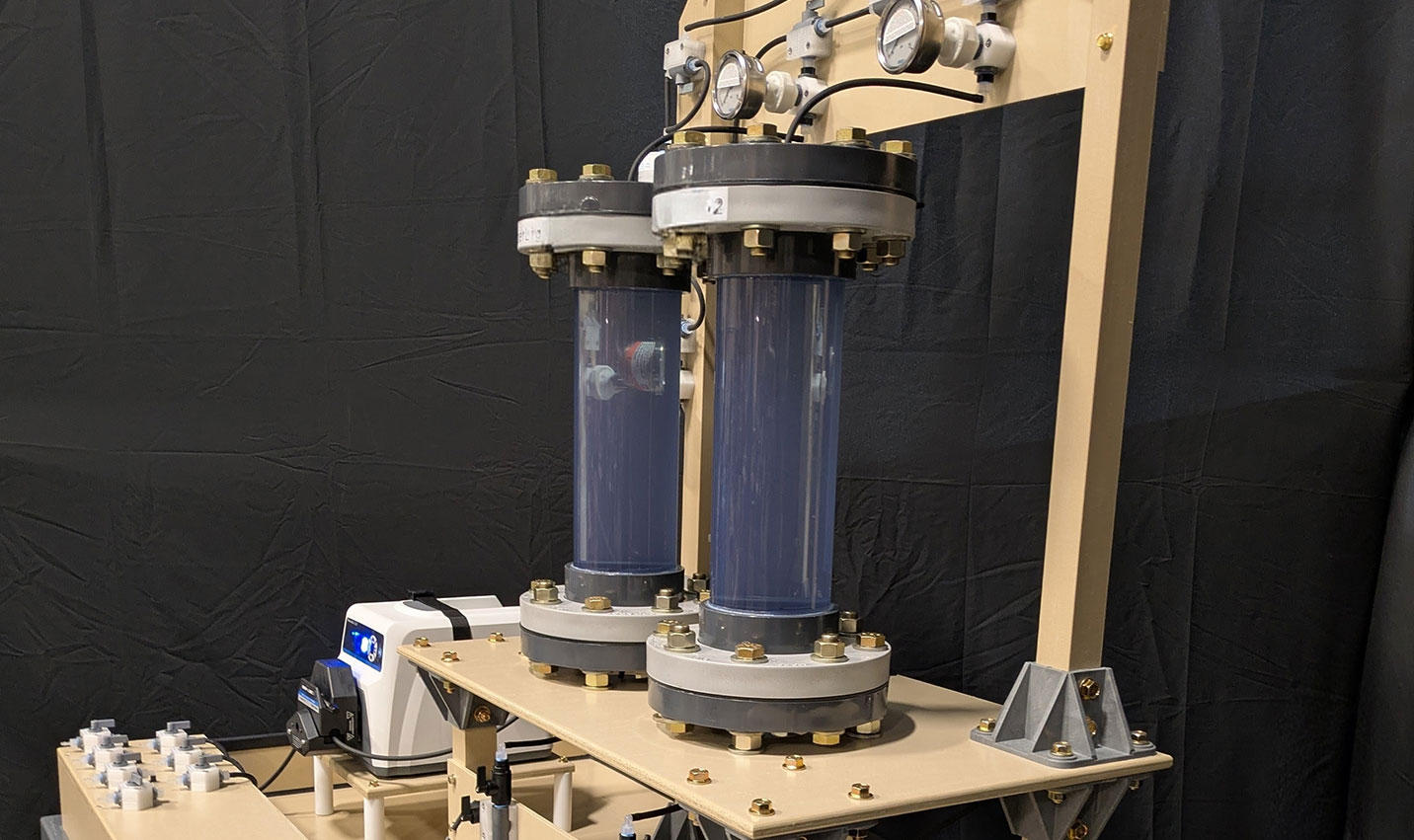
In lead recovery applications, MRT™ systems employ SuperLig® resins designed to selectively bind Pb²⁺ ions from aqueous streams. Feed solutions pass through a gravity-fed column packed with the selective SuperLig® resin. Lead ions are captured while other dissolved metals pass through the column untreated. Once the SuperLig® resin becomes loaded, a small volume of elution solution releases the captured lead in concentrated form for recovery or safe disposal.
This approach enables several operational advantages:
- Selective separation of lead even at mg/L or lower concentrations
- 99%+ lead removal efficiency
- High-purity recovery of the separated metal
- Concentration of lead by 100× or more during elution
- Minimal chemical consumption and reduced waste generation
Demonstrated Performance in Industrial Waste Streams
Pilot-scale demonstrations have shown that MRT™ can selectively remove lead even from extremely complex industrial mixtures.
In one study, a solution derived from acid extraction of melted fly ash contained high concentrations of multiple metals, including zinc, iron, aluminum, copper, cadmium, arsenic, and antimony. Lead concentrations in the feed were approximately 1,800 mg/L, while other metals were present at both higher and lower concentrations. [7]
When this solution passed through a multi-column MRT™ system containing lead-selective SuperLig® resin, the results were striking. The MRT™ system achieved quantitative removal of lead, while the other metals passed through the system without significant retention. [7] The captured lead was then eluted in a small volume of solution, allowing it to be recovered in concentrated form.
This ability to isolate lead selectively from complex mixtures represents a major advantage over conventional separation technologies, which often require multiple treatment stages and extensive downstream purification.
Applications Across Mining and Industrial Operations
Because MRT™ separations operate effectively in dilute and complex solutions, the technology has broad applicability across mining, recycling, and environmental remediation sectors.
Examples of potential applications include:
- Acid mine drainage treatment
- Mining effluents and beneficiation streams
- Industrial wastewater
- E-waste recycling leach solutions
- Fly ash and combustion residues
- Groundwater remediation near legacy mining sites
In each case, MRT™ allows operators to selectively remove lead while leaving other metals unaffected, simplifying downstream processing and reducing treatment costs.
A Scalable Approach to Addressing Legacy Lead Pollution
Lead contamination from historic mining and industrial activity will remain an environmental challenge for decades to come. Abandoned mines, legacy waste streams, and contaminated soils continue to introduce lead into water systems long after the original industrial activity has ceased.
Addressing this problem requires technologies capable of removing toxic metals efficiently from complex solutions without introducing additional environmental burdens. By combining high selectivity, simple column-based operation, and the ability to recover lead in concentrated form, MRT™ provides the most efficient approach to removing toxic metals from contaminated waters. For mining operators, environmental engineers, and recycling companies, MRT™ offers a powerful tool for mitigating legacy pollution while supporting responsible resource management.
Sources
[1] The Northern Echo. Lead Mining. https://www.thenorthernecho.co.uk/history/mining/lead/
[2] Gov.uk. Abandoned metal mines in England: baseline length of rivers and estuaries polluted by harmful metals. March 2025. https://www.gov.uk/government/publications/abandoned-metal-mines-in-england-baseline-length-of-rivers-and-estuaries-polluted-by-harmful-metals/abandoned-metal-mines-in-england-baseline-length-of-rivers-and-estuaries-polluted-by-harmful-metals#:~:text=The%20UK%20has%20a%20long%20history%20of%20metal%20mining%20with,rivers%2C%20often%20causing%20serious%20pollution
[3] Financial Times. Transcript: Toxic Legacy — Episode 3, The Whisper and Scream. November 2025. https://www.ft.com/content/08e7c0ac-5e0e-452f-ba75-402bfbfbbc11?syn-25a6b1a6=1
[4] Unicef. 7 things to know about lead exposure. https://www.unicef.org/stories/7-things-know-about-lead-exposure
[5] Financial Times. Transcript: Toxic Legacy — Episode 1, Silent Danger. https://www.ft.com/content/f1a2951a-bfed-44b7-96bc-05db6c50d5ba?syn-25a6b1a6=1
[6] Unicef. The toxic truth. https://www.unicef.org/reports/toxic-truth-childrens-exposure-to-lead-pollution-2020
[7] Izatt RM, Izatt SR, Izatt NE, Bruening RL. Green chemistry molecular recognition processes applied to metal separations in ore beneficiation, element recycling, metal remediation, and elemental analysis. In: Beach ES, Kundu S, editors. Handbook of Green Chemistry Volume 10 – Tools for Green Chemistry. Anastas PT, series editor. Weinheim (Germany): Wiley-VCH; 2017. pp. 189–240.