


The Environmental Origins of Catalytic Converter Technology
The word smog brings to mind a gray, choking cloud—so integrated with the city that it seems impossible to escape. Irritating the nose, throat, and eyes, it clouds everything and leaves a film of grime on buildings, streets, and skin. Smog was once a common feature of major cities around the world. From industrial Victorian England to early-20th-century New York and mid-century Detroit, historical images often show skylines obscured by thick haze.
Public concern about worsening air quality and its health impacts reached a peak by the mid-1900s. One scientist deeply troubled by these developments was Eugene Houdry, a chemical engineer who had pioneered catalytic refining processes. In the 1950s, research on air pollution emerging from Los Angeles revealed the severity of automobile emissions. Alarmed by the findings, Houdry began developing technologies to reduce harmful exhaust gases from gasoline-powered vehicles [1].
The resulting innovations eventually contributed to a major regulatory milestone. By 1970, the first iteration of the Clean Air Act mandated that new vehicles sold from 1973 onward meet emissions standards requiring catalytic converters [2]. These devices have proven extraordinarily effective. Today, new passenger vehicles emit 98–99% fewer key tailpipe pollutants than vehicles from the 1960s [3].
How Catalytic Converters Reduce Vehicle Emissions
Housed in a metal casing mounted along the vehicle’s exhaust system, catalytic converters accelerate chemical reactions that transform harmful exhaust components into less harmful gases. Through catalytic oxidation and reduction reactions, pollutants such as unburned hydrocarbons, particulate matter, and carbon monoxide are converted into water vapor, carbon dioxide, and nitrogen [4].
At the heart of this process are platinum group metals (PGMs)—primarily platinum, palladium, and rhodium. These elements possess exceptional catalytic properties and chemical durability, enabling them to withstand extreme temperatures and corrosive environments inside the exhaust stream.
Their importance is reflected in global production trends. Roughly 80 percent of all PGMs ever mined have been produced since 1980, and well over half of those metals are used in catalytic converters. In the case of rhodium, more than 95 percent of global demand comes from catalytic converter applications [5].
Catalytic Converter Recycling and Urban Mining
Despite their value and importance, PGMs are among the rarest elements in Earth’s crust. Economically viable deposits are concentrated in only a few regions worldwide, most notably South Africa and Russia. Mining these metals is energy-intensive and can place significant pressure on surrounding ecosystems through land disturbance, water consumption, and chemical waste generation.
At the same time, global demand for catalytic converters—and therefore PGMs—remains strong. Although electric vehicles are growing in market share, gasoline-powered vehicles continue to dominate global fleets, particularly in developing economies.
For this reason, catalytic converter recycling has become an increasingly important part of the global PGM supply chain [6].
Spent catalytic converters function as what experts often call an urban mine. Unlike natural ore deposits, which may contain less than 10 grams of PGMs per metric ton, catalytic converter materials can contain around 2,000 grams per metric ton [5]. In other words, end-of-life converters represent a highly concentrated and valuable secondary resource. It is estimated that recycling catalytic converters consumes 90% less energy that mining PGMs from ore.
When processed in appropriate facilities, recovery rates for PGMs can exceed 95 percent. This dramatically reduces the environmental footprint associated with obtaining these metals while also improving supply security.
Technical Challenges in Catalytic Converter Recycling
Although catalytic converter recycling offers clear advantages, recovering platinum, palladium, and rhodium from spent catalysts is technically demanding.
First, recycling systems must achieve a high degree of selectivity in order to separate valuable PGMs from base metals and other components present in the catalyst substrate. Converter materials often contain aluminum, cerium, iron, nickel, and other elements that complicate separation processes.
Second, feedstock variability is a major challenge. The composition of spent catalytic converters varies significantly depending on factors such as vehicle manufacturer, catalyst design, and operating conditions over the converter’s lifetime.
Finally, complex separation flowsheets can increase costs and waste generation. Each additional step in a conventional hydrometallurgical or pyrometallurgical process consumes energy and chemicals, reducing both economic and environmental benefits.
Technologies that can selectively recover PGMs while minimizing processing steps, chemical consumption, energy use and waste generation are therefore critical to advancing catalytic converter recycling.
Achieving Highly Efficient PGM Recovery with Molecular Recognition Technology® (MRT™)
Molecular Recognition Technology® (MRT™) is an advanced separations technology using highly selective SuperLig® resins to capture valuable metals, such as platinum, palladium and rhodium, from complex aqueous solutions.
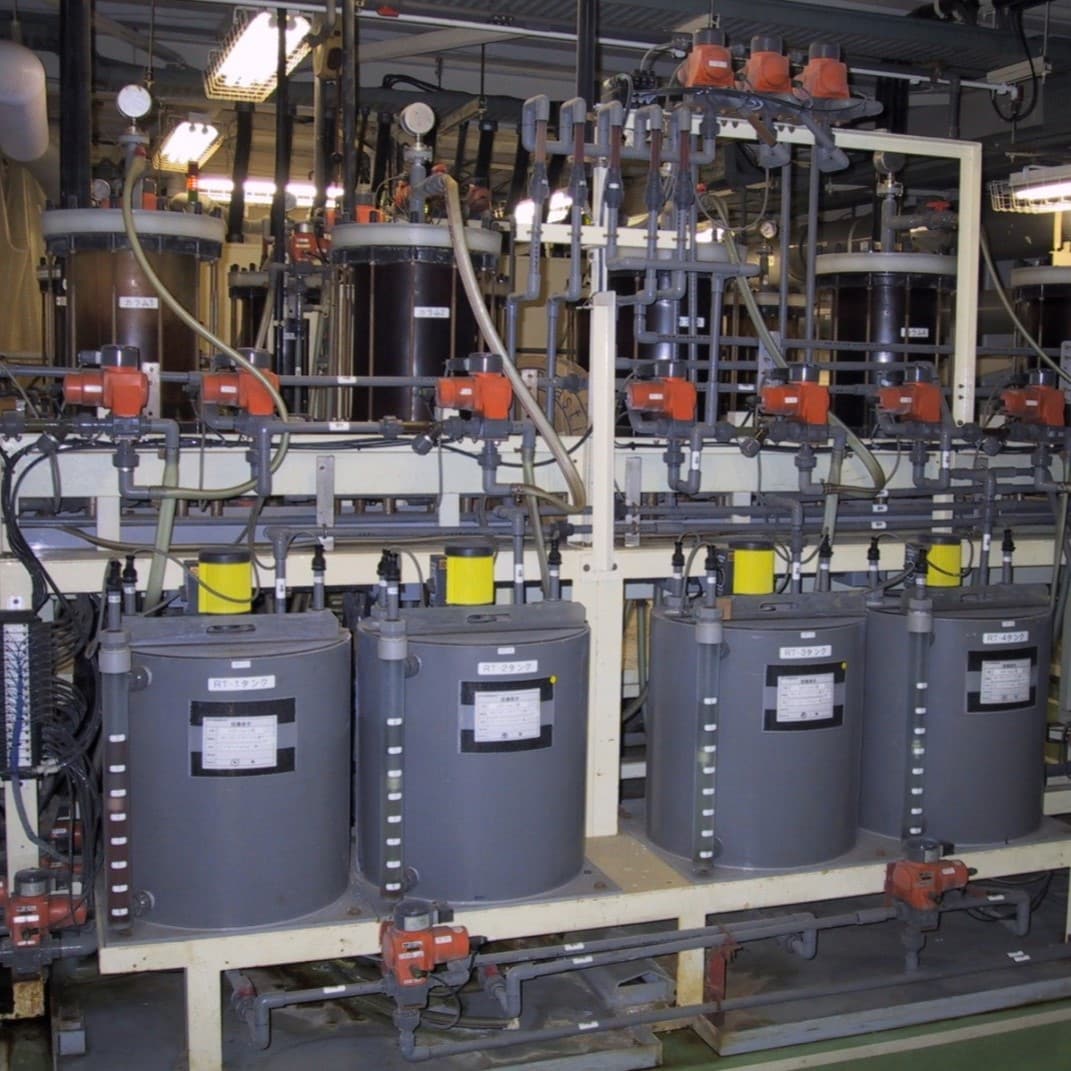
MRT™ is based on principles of supramolecular chemistry and functions at the molecular level in accordance with green chemistry and green engineering principles [7]. MRT™ systems operate in a packed column mode; employ SuperLig® resins, consisting of pre-designed organic ligands covalently bound to silica gel or polymeric particles by a tether, that are highly selective for individual target metals; have small space requirements; do not use solvents or highly corrosive chemicals; and produce pure, concentrated target metal products rapidly with short metal inventory times [8].
During catalytic converter recycling, PGMs are first brought into solution through hydrometallurgical processing. The leach solution is then passed through an MRT™ fixed bed column system containing the appropriate SuperLig® resins. Each target metal—palladium, platinum, or rhodium—is selectively captured by the appropriate SuperLig® resin while other metals pass through the column.
Once the SuperLig® resin becomes loaded with the target metal, it is washed and then eluted with a small volume of solution to produce a highly concentrated and purified product stream High metal selectivity and high metal affinity make possible separations of individual PGM at high purity, usually in a single step. The resulting raffinate does not contain traces of the target PGM that would require further separation steps downstream. Elution of the target metal with a small amount of eluent results in a concentrated eluate stream from which the final pure product can be easily retrieved [5].
High Purity and Efficient Separation of Platinum Group Metals
One of the key advantages of MRT™ systems is their ability to produce extremely pure metal products. Industrial implementations have demonstrated single-pass product purities ranging from 99.95% to 99.99% for individual platinum group metals, including palladium, platinum, and rhodium [5].
This high selectivity reduces the need for multiple downstream purification stages that are common in conventional separation methods such as solvent extraction or precipitation. As a result, MRT™ can significantly simplify refinery flowsheets while maintaining high recovery efficiency.
MRT™ performs effectively in streams containing high concentrations of base metals and/or relatively low concentrations of PGMs. This capability is particularly important in catalytic converter recycling, where feedstock composition varies widely depending on the type and condition of the spent catalyst material.
Process and Sustainability Advantages
Beyond high selectivity and purity, MRT™ systems offer several operational advantages for platinum group metals refining. These include:
- Simplified separation flowsheets
- Faster processing kinetics
- Reduced in-process metal inventories
- Lower chemical and energy consumption
- Reduced capital and operating costs compared with conventional methods
Equally important, MRT™ systems align closely with the principles of green chemistry and green engineering. By minimizing solvent and energy use, reducing waste generation, and enabling efficient recovery of valuable metals from secondary resources, MRT™ supports more sustainable supply chains for critical materials [6].
Advancing the Future of Catalytic Converter Recycling
The industrial-scale adoption of MRT™ in the mid-1990s by a top secondary PGM refiner, Tanaka Kikinzoku Kogyo, K.K. and a top primary PGM refiner, Impala Platinum Limited, marked the first disruptive innovation in PGM refining since the early widespread use of solvent extraction, ion exchange and precipitation in the mid-20th century. The use of these conventional technologies began at a time when much less attention was paid to clean chemistry operations and environmental issues associated with PGM refining [9].
As demand for platinum, palladium, and rhodium continues to grow, improving the efficiency and sustainability of catalytic converter recycling will remain an important priority for the mining and recycling industries.
Molecular Recognition Technology® has established itself as the industry standard for unlocking the full value of urban mines. By providing the benchmark for highly selective recovery of PGMs from complex feedstocks, MRT™ systems reduce waste, simplify refining processes, and help ensure that critical metals remain available for future generations of clean-air technologies.
In an era where both environmental stewardship and resource security are paramount, highly efficient catalytic converter recycling using Molecular Recognition Technology® will play an increasingly vital role in building a more circular and sustainable metals economy.
Sources
[1] York, A., 2011. The Evolution of Catalytic Converters. Royal Society of Chemistry. June.
https://edu.rsc.org/feature/the-evolution-of-catalytic-converters/2020252.article
[2] Roberts, J., 2015. Clean Machine. Science History Institute. January.
https://www.sciencehistory.org/stories/magazine/clean-machine/
[3] United States Environmental Protection Agency, 2015. Accomplishments and Successes of Reducing Air Pollution from Transportation in the United States. May.
https://www.epa.gov/transportation-air-pollution-and-climate-change/accomplishments-and-successes-reducing-air
[4] Woodford, C. 2026. Catalytic Converters. Explain That Stuff. March.
https://www.explainthatstuff.com/catalyticconverters.html
[5] Xiaotang, H., Xilong, W., Huan, W., Izatt, S. R., and Bruening, R. L., 2016. Processing of Spent Automotive Catalysts Using SuperLig® Molecular Recognition Technology (MRT) Products, International Precious Metals Institute 40th Annual Conference, Orlando, Florida, June 11-14.
[6] Izatt, S. R., Izatt, R. M., Bruening, R. L., and Izatt, N. E., 2019. Identification and Analysis of Platinum Group Metal Value Chains in Europe and the United States, International Precious Metals Institute 43rd Annual Conference, Reno, Nevada, June 15-18.
[7] Izatt, R.M., Izatt, S.R., Izatt, N.E., Krakowiak, K.E., Bruening, R L., Navarro, L., 2015. Industrial Applications of Molecular Recognition Technology to Green Chemistry Separations of Platinum Group Metals and Selective Removal of Metal Impurities from Process Streams, Green Chemistry, 17, 2236-2245.
[8] Izatt, S.R., McKenzie, J.S., Bruening, R.L., Izatt, R.M., Izatt, N.E., Krakowiak, K.E., 2016. Selective Recovery of Platinum Group Metals and Rare Earth Metals from Complex Matrices using a Green Chemistry-Molecular Recognition Technology Approach, in Metal Sustainability: Global Challenges, Consequences, and Prospects, Izatt, R.M. (Ed.), Wiley, Oxford, U.K. pp. 317-332.
[9] Izatt, S. R., Izatt, R. M., Bruening, R. L., Krakowiak, K. E., and Navarro, L., 2023. Platinum Group Metals: Highly selective Separations by MRT™ (Molecular Recognition Technology™) – Review of Individual Separations of Palladium, Platinum, Rhodium, Iridium and Ruthenium from Industrial Feedstocks and Comparison with Classical PGM Separation Processes, The IPMI Journal, Volume 4, pp. 77-115.