

A continent of extreme geological wealth, Africa contains some 30 percent of the world’s critical mineral reserves, 40 percent of the world’s gold and up to 90 percent of its chromium and platinum. The largest reserves of cobalt, diamonds, platinum and uranium in the world are in Africa [1]. Although African nations bear the environmental and social costs of extensive mining, very little of these rare metals are refined and manufactured into final products locally. Instead, that added value is exported to the Northern Hemisphere. Breaking this pattern, however, is possible. Technology that refines, manufactures, and recycles these metals on-site can keep that value where the ore is dug. In light of a growing green hydrogen economy, the goal of containing the value of mining, refining, manufacturing, and recycling precious metals on the African continent can be realized. An excellent case study of this is the South African company Isondo Precious Metals (IPM), which operates at the intersection of critical minerals and green hydrogen.
Renewable electricity from solar and wind is cheap and abundant in much of Africa, but it is also intermittent. The sun sets; the wind drops. To turn a sunny afternoon into power you can use at midnight or ship overseas, you need a way to store energy in a dense, transportable form. Hydrogen, made possible by electrolyzers, is one of the most promising answers.
The technology of hydrogen energy
An electrolyzer is an electrochemical device that converts electricity and water into hydrogen and oxygen, gases that can then be stored and used later. It can stabilize an electrical grid fed by diverse sources such as wind turbines and solar cells, or produce hydrogen locally as a fuel. The “reverse” technology is the fuel cell, wherein a chemical reaction between hydrogen and oxygen produces electricity, with its only byproducts being heat and water. Together, they enable a zero-emission energy cycle where excess renewable power can be stored as chemical energy and converted back to electricity on demand.
The most advanced hydrogen technology is built around the proton exchange membrane, or PEM. In a PEM fuel cell, hydrogen gas enters the anode, where a catalyst splits the molecules into protons and electrons; the membrane lets only protons through, forcing the electrons around an external circuit to create an electric current, and the protons recombine with oxygen at the cathode to produce water and a little heat. A PEM electrolyzer does the opposite, using a solid polymer electrolyte to shuttle protons while electricity drives the water-splitting. The catalyst layers are printed as inks onto the membrane to form a catalyst-coated membrane, which is then assembled into a membrane electrode assembly (MEAs), the finished value-added product.
Absolutely irreplaceable to PEM catalysts are platinum and iridium. These metals are grouped within the Platinum Group Metals (PGMs), a particularly valuable group of metals because of their dense, hard natures. They are resistant to wear, chemical degradation, heat, and have high mechanical strength. Combined with chemical stability, these characteristics make platinum and iridium uniquely useful in PEM catalysts, and thus far impossible to replace. Both metals are rare and expensive; roughly 7.5 tons of iridium are mined per year, compared with about 200 tons of platinum. In order to maintain an economically viable MEA supply, catalysts contain very little metal, and recovering every gram possible from spent MEAs is critical. Because of this, the efficient recycling of MEAs in order to reclaim the PGMs used within them is a central part of hydrogen energy.
South Africa mines the overwhelming majority of the world’s platinum and iridium: 74% and 88% respectively [2,3]. Although mined and often refined in country, the high-value step of turning them into MEAs happens in Europe, North America, and Asia, and the wealth created is captured abroad [4]. At the end of their lifecycle, MEA recycling is dominated by very few, large companies in Europe and Japan due to the difficulties of recycling PGMs, particularly iridium, from secondary feedstocks such as MEAs. As manufacturers use less PGMs in each cell and increasingly rely on alloys that blend several metals together, the material arriving for recycling carries lower concentrations of PGMs within ever more complex mixtures—all while environmental, safety, health, and economic pressures continue to mount [5]. However, PGMs can be endlessly recycled, making this an important revenue stream. Recycling, as well as manufacturing MEAs is a way for the natural abundance of South Africa to translate into material wealth for its citizens.
Refining, manufacturing, and recycling in South Africa
IPM, a PGM technology company, is helping to realize this opportunity by converting South Africa’s PGMs into high-value fuel-cell components such as catalyst-coated membranes (CCMs) and MEAs within South Africa. Rather than exporting platinum as a refined commodity, local manufacturing enables additional value to be captured through catalyst preparation, precision coating, quality assurance, process know-how and intellectual property. Publicly available fuel-cell manufacturing cost studies indicate that one gram of platinum worth approximately US$58 as refined metal can generate around US$110 of value when incorporated into a commercial CCM, representing an increase in domestic value capture of almost 90%. For the approximately 12 grams of platinum contained in a typical fuel-cell vehicle, this translates into an opportunity to increase the value retained in South Africa from around US$700 as exported metal to more than US$1,300 through local CCM production, before accounting for the additional benefits of skilled employment, technology development and export growth.
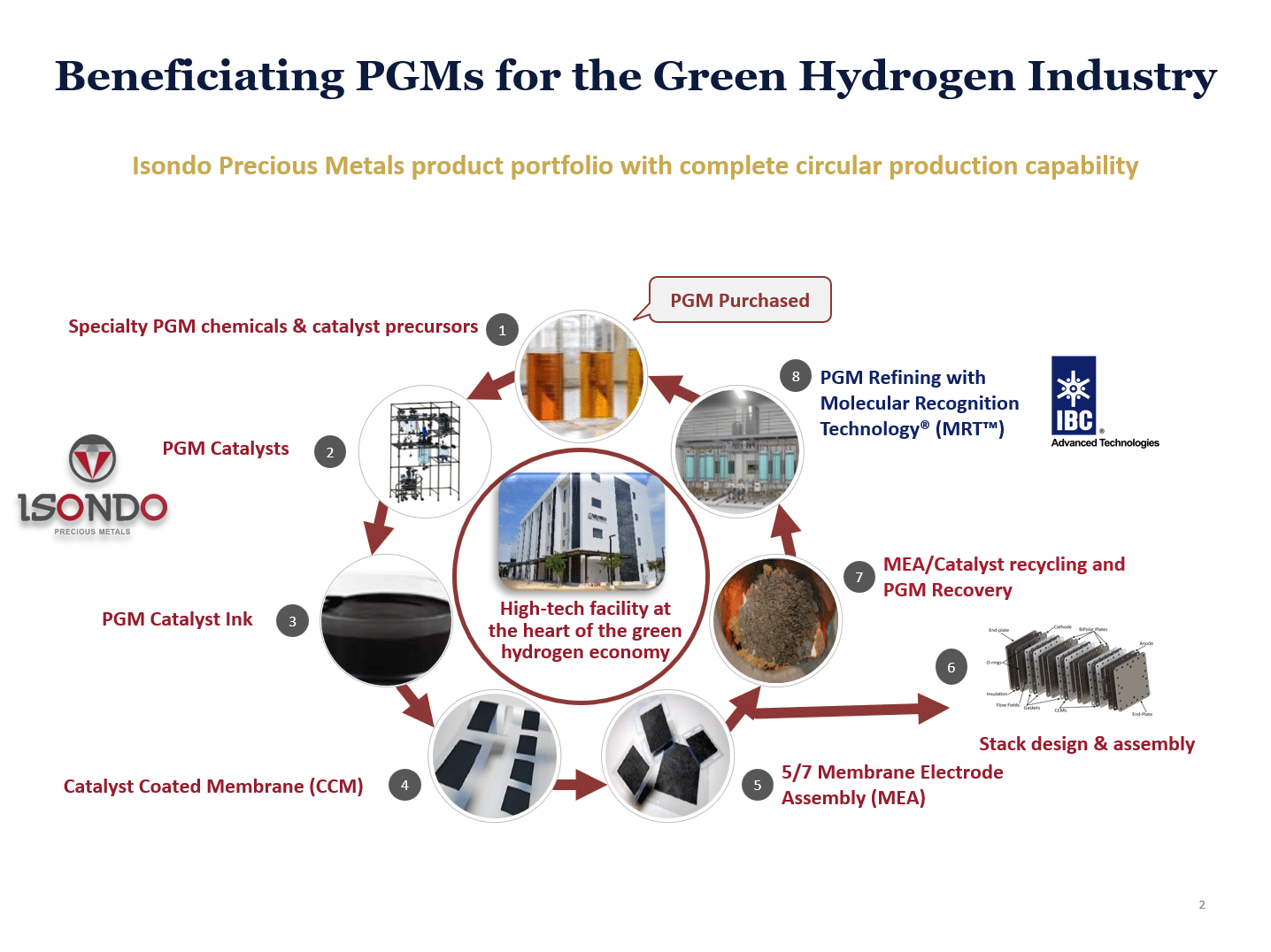
IPM is dedicated to keeping the entire supply chain in house, creating multiple revenue streams under one roof. Their plant runs the whole sequence: PGM procurement, specialty PGM chemicals and catalyst precursors, catalysts, catalyst ink, catalyst-coated membranes, MEA assembly, in-house testing, and, crucially, closed-loop recycling and refining of the metals recovered from spent components.
In 2021, IBC Advanced Technologies, Inc. (IBC) was selected to supply SuperLig® Molecular Recognition Technology® (MRT™) systems for recycling platinum group metals for IPM, both from IPM’s own manufacturing operations and from spent secondary materials such as autocatalytic converters and other concentrate feedstocks [6]. The ability to recycle and refine PGMs from complex blends of secondary materials makes IPM unique within Africa; other refineries of PGMs on the continent handle primary feeds.
Traditionally, PGMs such as iridium are recycled with precipitation, solvent extraction, or ion exchange, each of which has significant drawbacks [5], making them impractical for refining of iridium from complex feeds. Precipitation is perhaps the least effective of these, as it uses chemicals hazardous to the environment and the health of exposed workers. It is not economically ideal, as it’s difficult to automate and requires multiple steps. Solvent extraction, while more efficient than precipitation, requires time and resource intensive secondary processing and flammable, harsh solvents. Ion exchange has poor first pass recoveries, requiring extensive secondary processing and consumption of huge amounts of energy [7]. MRT™ excels where these traditional forms of PGM refining fail: It is a superior technology that is environmentally and worker health safe, economical, easy to scale and automate, uses low amounts of energy, and is extremely selective [8].
By using supramolecular host–guest chemistry to design SuperLig® resins that recognize a specific target metal ion, MRT™ achieves very high single-pass recovery yields and exceptional product purities [9]. Because the chemistry works at the molecular level with rapid binding and release kinetics, MRT™ can be slotted into plant flowsheets in real time, fully automated via SCADA, and run in compact, simple column systems that need little space, labor, or infrastructure, requiring markedly lower capital and operating costs than the alternatives [5].
MRT™ has been in commercial use for PGM refining in South Africa and around the world since the mid-1990s [5]. Sibanye-Stillwater has operated an iridium refining circuit using MRT™ since 2015 at its Brakpan, South Africa PGM refinery [10].
The simplicity of MRT™ flowsheets for fuel cells, electrolyzers and catalytic converters has been demonstrated on IPM surrogate feeds [11]. Highly predictable, repeatable and commercially viable recovery rates were demonstrated while maintaining catalyst-grade purity. Iridium, Platinum, Ruthenium, Rhodium and Palladium were individually separated as high purity metals. The flowsheets operate at room temperature and incorporate simple wash and elution reagents including water, dilute HCl, NaCl and KCl. Importantly, the flowsheet for catalytic converter recycling can be adjusted to separate either Rh or Pd first, optimizing metal velocity and maximizing commercial return.
MRT™ is a fundamentally green-chemistry, green-engineering approach: it avoids organic solvents and harsh chemicals (using only mild reagents like water, dilute acids, and simple salts that can often be recycled), operates without energy-intensive heating, pressurization, or resin burning, and lets the SuperLig® resins be reused over many cycles. The result is minimal waste generation, a minimal carbon footprint, easier permitting, and fewer environmental and community conflicts, while the closed, contained system also sharply reduces health and safety risks.
The unique ability of MRT™ to concentrate metal a hundredfold or more in the elution step makes treating dilute secondary feeds of PGMs, such as those from MEAs, economically feasible. This is the critical final step in the goal of a truly circular and sustainable hydrogen energy economy—one rooted and realized in South Africa.
Sources
[1] Our Work in Africa. UN environment programme. https://www.unep.org/regions/africa/our-work-africa
[2] Dresyamaya Fiona. The World’s Top Platinum Producers 2024. ACM Exchange. https://asiacommodity.market/insights/the-worlds-top-platinum-producers-2024
[3] Raw Materials Profiles- Iridium. European Commission. https://rmis.jrc.ec.europa.eu/rmp/Iridium
[4] Membrane Electrode Assembly Market Size, Share & Industry Analysis, By Component (Membranes, Gas Diffusion Layers, Gaskets, and Others), and by Application (Proton Exchange Membrane Fuel Cells (PEMFC), Direct Methanol Fuel Cells (DMFC), Electrolyzers, and Others) and Regional Forecast, 2026-2034. Fortune Business Insights. 2026. https://www.fortunebusinessinsights.com/industry-reports/membrane-electrode-assemblies-mea-market-101346
[5] Izatt, S. R., Izatt, R. M., Bruening, R. L., Krakowiak, K. E., and Navarro, L., 2023. Platinum Group Metals: Highly selective Separations by MRT™ (Molecular Recognition Technology™) – Review of Individual Separations of Palladium, Platinum, Rhodium, Iridium and Ruthenium from Industrial Feedstocks and Comparison with Classical PGM Separation Processes. The IPMI Journal, Volume 4, pp. 77-115.
[6] IBC Selected by Isondo Precious Metals to Supply SuperLig® Molecular Recognition Technology (MRT) System for Platinum Group Metals and Gold Production, 2021. PR Newswire. https://www.prnewswire.com/news-releases/ibc-selected-by-isondo-precious-metals-to-supply-superlig-molecular-recognition-technology-mrt-system-for-platinum-group-metals-and-gold-production-301336089.html
[7] Crundwell, F. et al., 2011. Refining of the Platinum Group Metals. Extractive Metallurgy of the Platinum Group Metals, Elsevier, pp 489-536
[8] Izatt, R.M., Izatt, S.R., Izatt, N.E., Krakowiak, K.E., Bruening, R L., Navarro, L., 2015. Industrial Applications of Molecular Recognition Technology to Green Chemistry Separations of Platinum Group Metals and Selective Removal of Metal Impurities from Process Streams. Green Chemistry, 17, pp 2236-2245.
[9] R. M. Izatt, S. R. Izatt, N. E. Izatt, R. L. Bruening, and K.E. Krakowiak, 2017. Green Chemistry Molecular Recognition Processes Applied to Metal Separations in Ore Beneficiation, Element Recycling, Metal Remediation, and Elemental Analysis in Handbook of Green Chemistry Volume 10: Tools for Green Chemistry First Edition, E S. Beach and S. Kundu, Ed., Wiley-VCH Verlag GmbH & Co. KGaA, ch. 9, pp. 189-240.
[10] P. Kwinana and T. Masinga, S. R. Izatt, R. L. Bruening, J. Kujanpää, R.M. Izatt, 2021. Industrial-Scale Refining of Iridium at Sibanye-Stillwater’s South African Precious Metals Refinery Using SuperLig® Molecular Recognition Technology™ (MRT™), in Proceedings of the International Precious Metals Institute (IPMI) 45th Annual Conference, Reno, NV, USA, October 6-9.
[11] S. R. Izatt and V. Somera, 2026. The Refining of Iridium and Rhodium using Molecular Recognition Technology® (MRT™), Proceedings of the International Precious Metals Institute (IPMI) 50th Annual Conference, Orlando, Fl, USA, June 6-9.