

The Growing Demand for Ac-225 in Targeted Alpha Therapy
Cancer researchers at leading institutions worldwide are investigating one of the rarest and most promising substances in modern medicine. Actinium-225 (Ac-225), a highly radioactive isotope used in targeted alpha therapy (TAT), has demonstrated significant therapeutic potential, but clinical development and commercialization remain constrained by limited global supply and the complexity of production.
Ac-225 is widely regarded as one of the most promising isotopes for targeted alpha therapy. Both Ac-225 and its short-lived daughter isotope, bismuth-213 (Bi-213) emit alpha particles during radioactive decay. Compared with beta particles, alpha particles deliver substantially higher energy over very short distances, enabling highly localized destruction of targeted cancer cells while minimizing damage to surrounding healthy tissue. [1] With a half-life of approximately 10 days, Ac-225 provides a practical therapeutic window for radioligand manufacturing, distribution and clinical use. [2]
Clinical research involving Ac-225 targeted alpha therapies has demonstrated encouraging results for patients with cancers that have not responded to conventional treatment approaches. Two studies on prostate cancer, one of the most common cancers in the world, show a compelling picture of where Ac-225 radioligand therapy stands today. A retrospective study taking place between 2016-2023 in 7 centers across 4 countries followed 488 men with metastatic castration-resistant prostate cancer, the overwhelming majority of whom had exhausted all other approved treatment options. These men received Ac-225-PSMA radioligand therapy, and the results were striking for a population with so few remaining options. Prostate-specific antigens, proteins measured to approximate the number of malignant cells in an unhealthy prostate, declined in 73% of patients, with a reduction of 50% or more recorded in 57%, and the median overall survival reached 15.5 months. [3] A second study conducted by researchers at the University of Southern California provides the mechanistic and developmental scaffolding that contextualizes those results: Ac-225 carries a half-life of 9.92 days, during which its decay chain releases four net alpha particles per decay event — a cascade that maximizes therapeutic potency. Both studies identify limited Ac-225 availability as one of the primary barriers to broader clinical adoption and commercialization of targeted alpha therapies. [3][4]
The Growing Demand for Ac-225 in Targeted Alpha Therapy
Ac-225 does not occur in nature in any commercially meaningful quantities; it must be produced in specialized reactors or particle accelerators from thorium or radium targets, followed by complex multi-step chemical separation processes conducted in shielded hot cell environments. Current production methods have limited global supply of Ac-225 to approximately 63 gigabecquerels annually, enough to sustain treatment for only 100 to 200 patients worldwide each year. [5] Expanding access to Ac-225 will require more scalable, efficient and cost-effective production and purification technologies capable of improving isotope recovery, reducing waste generation and simplifying separation flowsheets.
Supply Constraints Continue to Limit Commercialization
Global shortages of Ac-225 have created uncertainty for isotope suppliers, drug developers and healthcare providers. Supply interruptions and limited production capacity have increasingly become a concern for ongoing oncology clinical trials and future commercial therapies.
In addition to supply constraints, manufacturers face growing regulatory scrutiny regarding impurity profiles and the consistency of radioisotope production processes. Existing separation technologies often require multiple processing steps, generate substantial waste streams and struggle to achieve the purity and recovery rates needed for commercial scale production and cGMP manufacturing environments. These challenges have increased the need for highly selective separation technologies capable of improving product purity while reducing process complexity and operational waste.
MRT™ Enables Highly Selective Separation of Critical Radioisotopes
IBC Advanced Technologies, Inc. (IBC) and its subsidiary, RadSep, have developed proprietary Molecular Recognition Technology® (MRT™) resins and flowsheets specifically designed for the highly selective separation and purification of critical radioisotopes used in targeted alpha therapy.
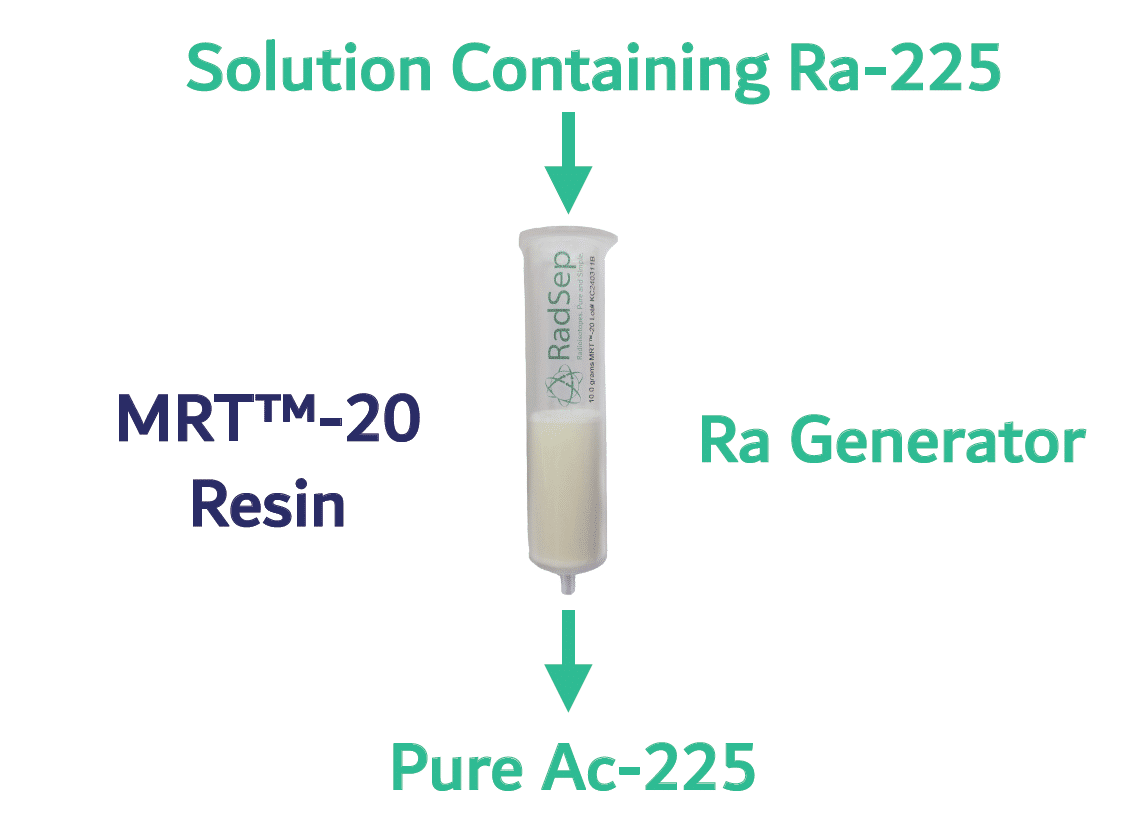
MRT™ ligands are engineered to selectively bind target ions according to their unique size, geometry and coordination chemistry. These ligands are covalently attached to support materials, including organic polymers and silicates, creating reusable MRT™ resins capable of operating in packed column systems with exceptional selectivity. [6]
Unlike conventional ion exchange systems, MRT™ resins can achieve highly selective, single-step separations using chemically simple eluents. This approach can significantly reduce process complexity while improving purity and recovery performance. MRT™ resins have demonstrated recovery rates approaching 100% and product purities as high as 99.99% for selected radioisotope separations. [7]
Independent studies have also demonstrated strong radium retention across a broad acid range, including 0.01 to 10 M HCl and HNO3, with distribution coefficients exceeding 250 L/kg. Additional published studies have reported reduced waste generation, lower operating costs and faster processing times compared with alternative resin-based separation methods. [8]
MRT™ Flowsheets Improve Recovery, Purity and Process Efficiency
IBC’s MRT™ flowsheets were developed to address both upstream and downstream radioisotope separations required for modern radiopharmaceutical production. These flowsheets support the purification and recovery of radioisotopes including Ac-225, Ra-226, Pb-212, Th-227 and Bi-213. [7][8]
A key advantage of MRT™ flowsheets is the ability to selectively recover and recycle valuable parent isotopes, particularly Ra-226 and Th-228. Improved recovery and recycling capability can help isotope producers maximize utilization of scarce source materials while reducing overall process losses and radioactive waste generation. [7]
The flowsheets were also designed to support scalability and operational reliability for commercial manufacturing environments. By simplifying separation steps and improving selectivity, MRT™ can help producers streamline production workflows while maintaining the high purity standards required for therapeutic applications. [7]
Industrial Scale Manufacturing Capability for the Radiopharmaceutical Industry
IBC brings more than three decades of experience in highly selective separations across mining, recycling, industrial processing and life sciences applications. IBC’s industrial manufacturing capabilities support production of MRT™ resins at commercial scale, positioning MRT™ to support the growing global demand for medical radioisotopes.
The launch of RadSep further expands IBC’s focus on radiopharmaceutical applications, including advanced separation technologies for isotopes used in radioligand cancer therapies. [8] MRT™ can also support waste minimization initiatives and improve sustainability within radioisotope production processes.
Supporting the Future of Targeted Alpha Therapy
As targeted alpha therapy continues to advance, reliable access to high purity radioisotopes will remain essential for clinical development and commercial manufacturing. MRT™, as a highly selective separations technology, offers a pathway to improved supply reliability, reduced waste generation and more efficient production of critical isotopes including Ac-225. [6][7]
By combining highly selective chemistry, scalable manufacturing and simplified flowsheet design, MRT™ is positioned to help address some of the most significant production challenges facing the radiopharmaceutical industry today.
Sources
[1] National Isotope Development Center. NIDC Newsletter. April 2013. https://www.isotopes.gov/sites/default/files/2018-01/NIDC_Newsletter_3.pdf
[2] Andrew Robertson, et. al. Development of 225Ac Radiopharmaceuticals: TRIUMF Perspectives and Experiences. December 2018. https://pmc.ncbi.nlm.nih.gov/articles/PMC6249690/
[3] Mike Sathekge, et. al. Actinium-225-PSMA radioligand therapy of metastatic castration-resistant prostate cancer (WARMTH Act): a multicentre, retrospective study. February 2024. https://pubmed.ncbi.nlm.nih.gov/38218192/
[4] Anil Bidkar, et. al. Actinium-225 targeted alpha particle therapy for prostate cancer. May 2024. https://pmc.ncbi.nlm.nih.gov/articles/PMC11103494/#sec12
[5] Mohamed Nawar, et. al. Actinium-225/Bismuth-213 as Potential Leaders for Targeted Alpha Therapy: Current Supply, Application Barriers, and Future Prospects. September 2025. https://pmc.ncbi.nlm.nih.gov/articles/PMC12468084/
[6] IBC Advanced Technologies. Life Sciences: Targeted Alpha Therapy, Brachytherapy and Enantiomer Separations. Accessed May 2026. https://ibcmrt.com/markets-and-applications/life-sciences-targeted-alpha-therapy-brachytherapy-enantiomer-separations/
[7] IBC Advanced Technologies. IBC Addresses Critical Supply Shortages of Ac-225 with Commercially Available Molecular Recognition Technology™ (MRT™) for Highly Selective Separation of Ac-225. June 2024. https://www.prnewswire.com/news-releases/ibc-addresses-critical-supply-shortages-of-ac-225-with-commercially-available-molecular-recognition-technology-mrt-for-highly-selective-separation-of-ac-225-302166202.html?tc=eml_cleartime
[8] IBC Advanced Technologies. IBC launches RadSep, Inc.: Best-in-class, highly selective separations using Molecular Recognition Technology™ (MRT™) for production of critical radioisotopes essential to cancer therapies. October 2024. https://www.prnewswire.com/news-releases/ibc-launches-radsep-inc-best-in-class-highly-selective-separations-using-molecular-recognition-technology-mrt-for-production-of-critical-radioisotopes-essential-to-cancer-therapies-302266340.html